English translation of the original personal essay; historical observations, figures and legal discussion reflect its publication date. Some photographs were not embedded in the supplied PDF; available images and the original captions are retained.
Van Gogh is said to have painted four versions of Irises: one in Amsterdam’s Van Gogh Museum, one at the Getty Museum in Los Angeles—the best-known, with a pink background—one at New York’s Metropolitan Museum of Art, with a tighter composition, and another in private hands. In July 2019, I admired the pink-background Irises at the Getty.
In July 2025, during a short academic exchange at Leiden University in the Netherlands, I was fortunate to see a second original at the Van Gogh Museum in Amsterdam. Its full title should be Vase with Irises. Painted in 1890, its deliberately asymmetric arrangement and spontaneous sense of natural growth break the usual equilibrium of a still life. A yellow background meets blue-violet flowers in a powerful collision of complementary colours. In European culture, irises are often associated with hope, rebirth and faith. In the context of Van Gogh’s later years, those associations resonate with his state of mind while recovering from mental illness.
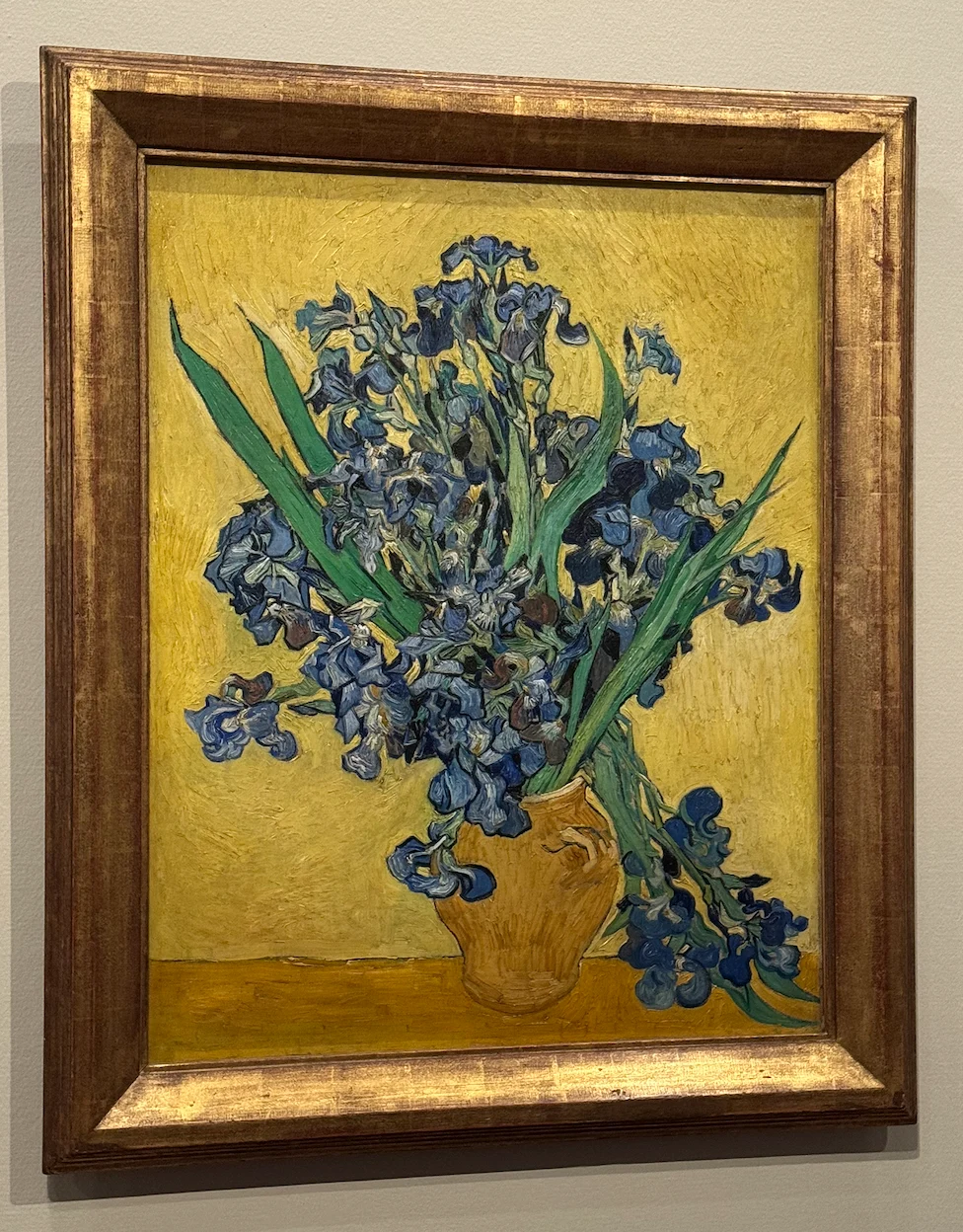
Vase with Irises.
Photograph by Mingyue Gao, Van Gogh Museum, July 2025.
Finding a little free time during my study trip, I had the good fortune to accompany several professors to the museum, having booked through the Qunar app. I had planned three hours, but our late arrival left only one. Even such a hurried visit made a deep impression. Located on Amsterdam’s Museumplein, the Van Gogh Museum holds the world’s richest collection of Vincent van Gogh’s work and is a place of pilgrimage for art lovers.
Electronic ticket for the Van Gogh Museum.
The Irises above is remarkable, though its reputation is more scholarly. In public recognition it cannot rival Sunflowers below, a treasure of the collection. One of Van Gogh’s most famous series and an iconic achievement of Post-Impressionism, Sunflowers is almost synonymous with his name. Between 1888 and 1889, he painted five versions in Arles, France, to decorate the Yellow House studio he was preparing for his painter friend Paul Gauguin. The surviving versions include the Van Gogh Museum’s 1889 canvas, whose originally pale-green background faded to pale blue, and the National Gallery in London’s 1888 version with its bright-yellow background. The other three are associated with Munich, Philadelphia and Tokyo; one was destroyed during the Second World War.
Mingyue Gao at the Van Gogh Museum.
In the West at the time, sunflowers symbolised warmth, loyalty and vitality. For Van Gogh, they expressed hope for friendship and artistic collaboration—the decorations for Gauguin’s room—and celebrated the sunshine and energy of southern France. Moving beyond traditional still-life representation, the painting pushes colour and brushwork to their limits, making them direct vehicles of emotion.
Another painting worth introducing is The Bedroom. Van Gogh made three versions. The first, painted in Arles in October 1888, is the largest and is held at the Musée d’Orsay in Paris. The second, painted at the Saint-Rémy asylum in September 1889, is at the Art Institute of Chicago, slightly smaller and softer in its somewhat different colours. The third, painted in Saint-Rémy in late 1889, is at the Van Gogh Museum in Amsterdam.
The Bedroom.
Mingyue Gao at the Van Gogh Museum.
Vivid blue walls, a yellow bed and orange chairs intensify the perception of space. Rough, slightly distorted furniture lines make the picture dynamic and expressive—innovative techniques in their time.
In just one hour I was able to enjoy dozens of Van Gogh’s masterpieces. How fortunate! Here are a few more to share.
Wheatfield with Crows.
Photograph by Mingyue Gao, Van Gogh Museum, July 2025.
With so many outstanding works to choose from, I am also sharing three self-portraits for you to enjoy.
Three self-portraits.
Photographs by Mingyue Gao, Van Gogh Museum, July 2025.