English translation of the original personal essay; historical observations, figures and legal discussion reflect its publication date.
Over the years, between study trips, visits to friends and work, I have visited many museums. Whether I was following a map in the early days or relying now on GPT’s itineraries and the Muse assistant’s guidance, museums have always been essential stops. In 2019, while taking my daughter to summer camp in America, I saw Van Gogh’s Irises at the Getty Museum in Los Angeles. I wrote that the little girl before the painting and the painting itself were both priceless. Later, at the Huntington, the Chinese Garden was captivating, but the names of successive trustees at the entrance held my thoughts longer: how can a person’s wealth continue to benefit strangers after that person has died?
Later still, in the Netherlands and on America’s East Coast, I kept returning to art museums. From Van Gogh in Amsterdam to Vermeer in The Hague, from Ru ware in Boston to The Night Café at Yale, experiences once scattered across cities began to connect. I cared about how works were created, but also how they were preserved and understood, and how they continued to participate in later lives after their makers and collectors had departed.
Yesterday, at the Louvre, these questions suddenly acquired a longer timescale.
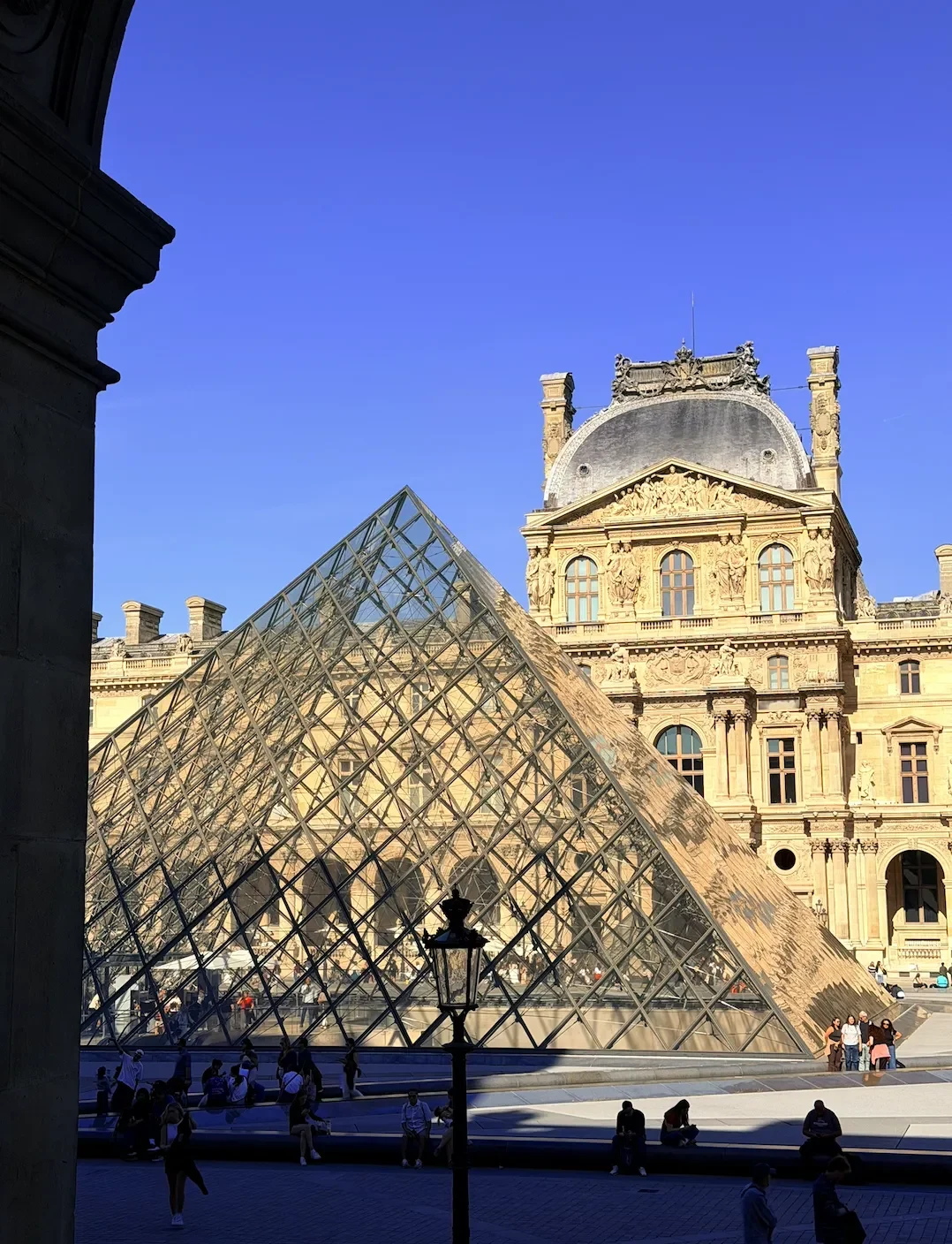
This museum, once a royal palace, holds gods, Madonnas, a merchant’s wife, emperors and disaster victims within the same space. Their former ranks remain inscribed in the images; today, however, we can look with equal seriousness at a crown and at an anonymous person’s hanging arm.
When I photographed these works, I wanted to keep the light and shadow before me. Sorting through the photographs later, I realised they had also gathered together the different versions of myself who had travelled to different places over the years.
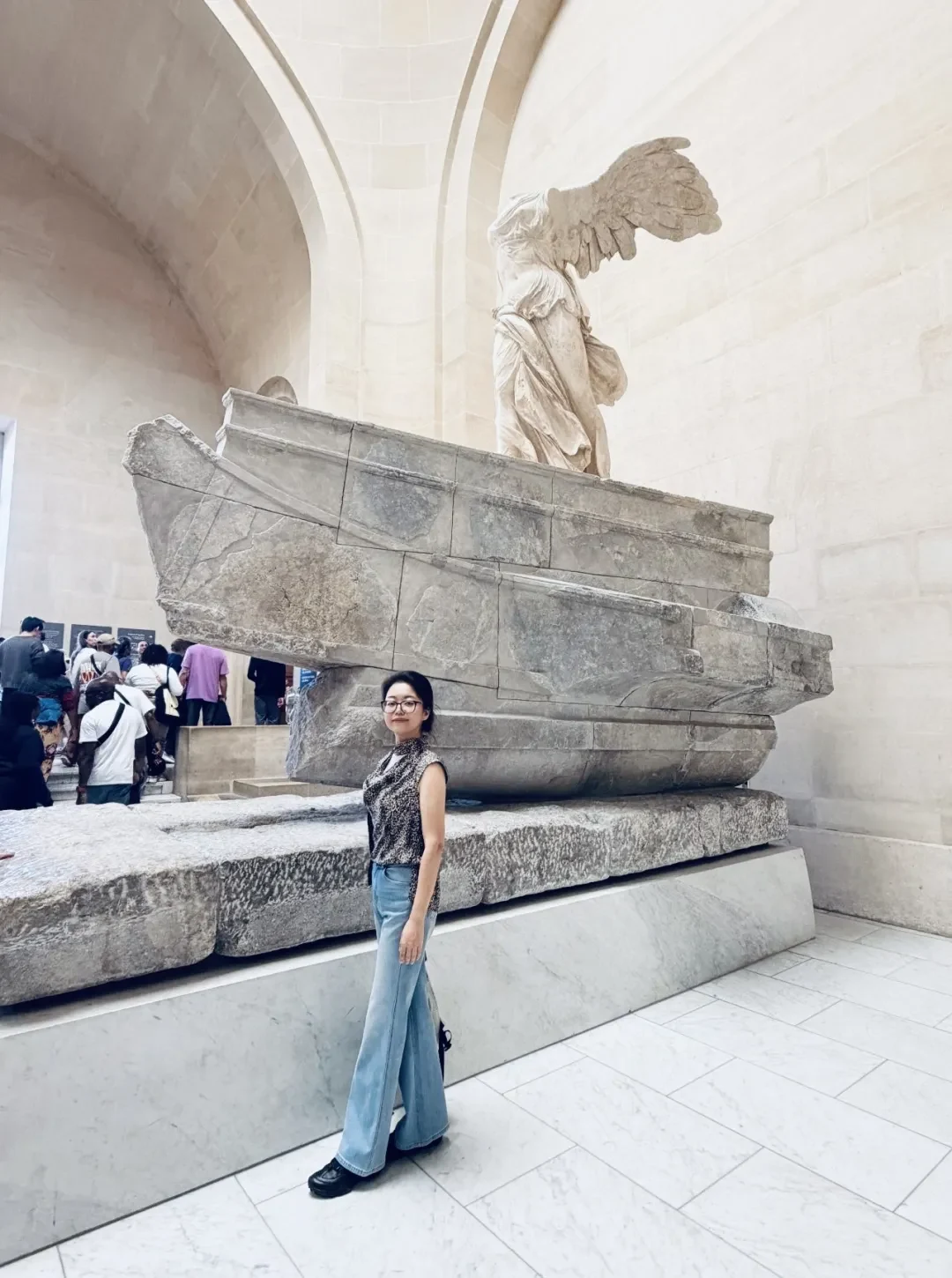
Ascending the Daru staircase, I saw the Winged Victory of Samothrace above me.
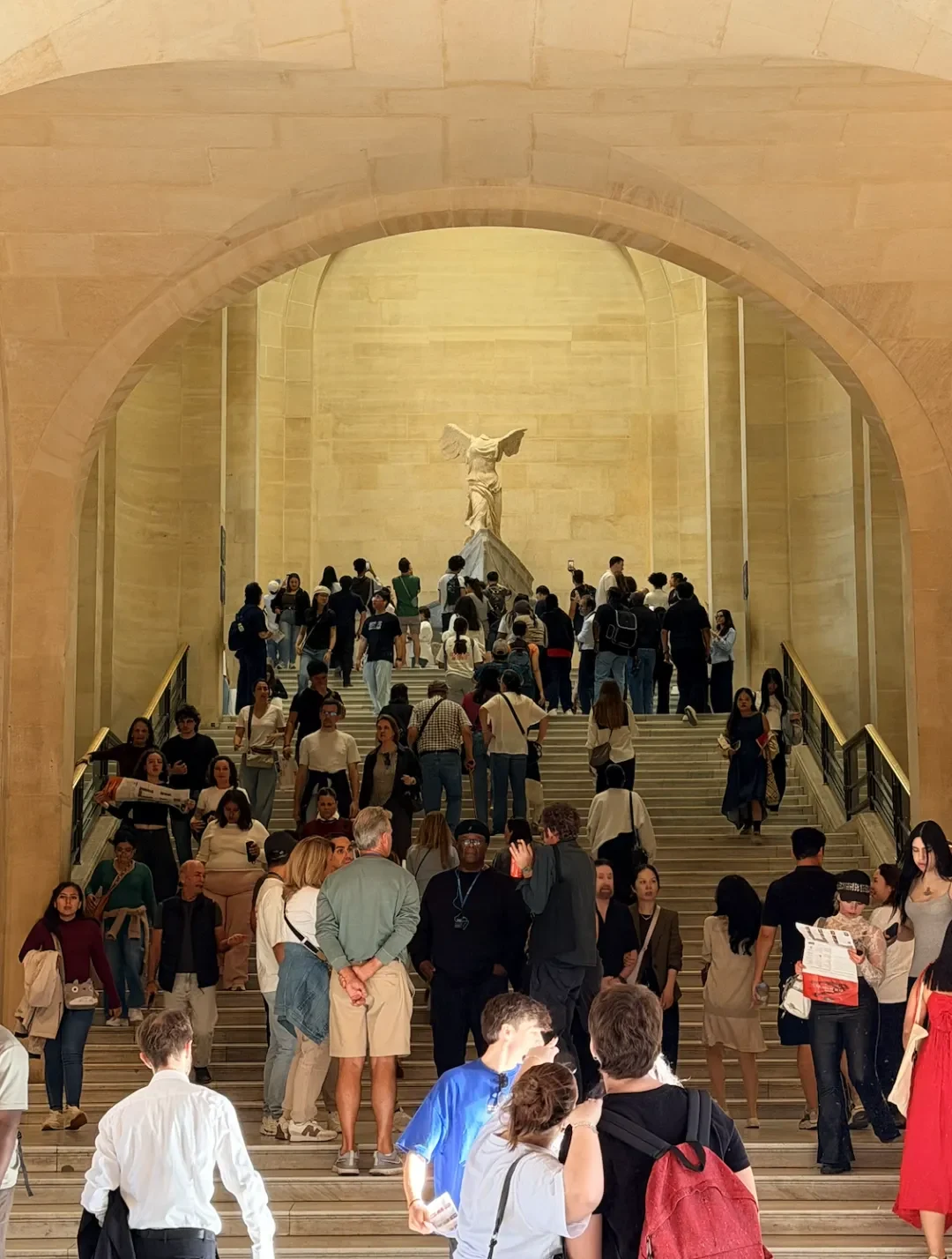
Before I could distinguish the folds of cloth, I felt a force coming towards me. The goddess stands on a ship’s prow, wings spread and body thrust forward, as though the sea wind has just arrived. Cloth clings to her abdomen and legs, then gathers in heavy folds at her side. Hard marble expresses the warmth of flesh, the weight of fabric and the speed of air all at once.
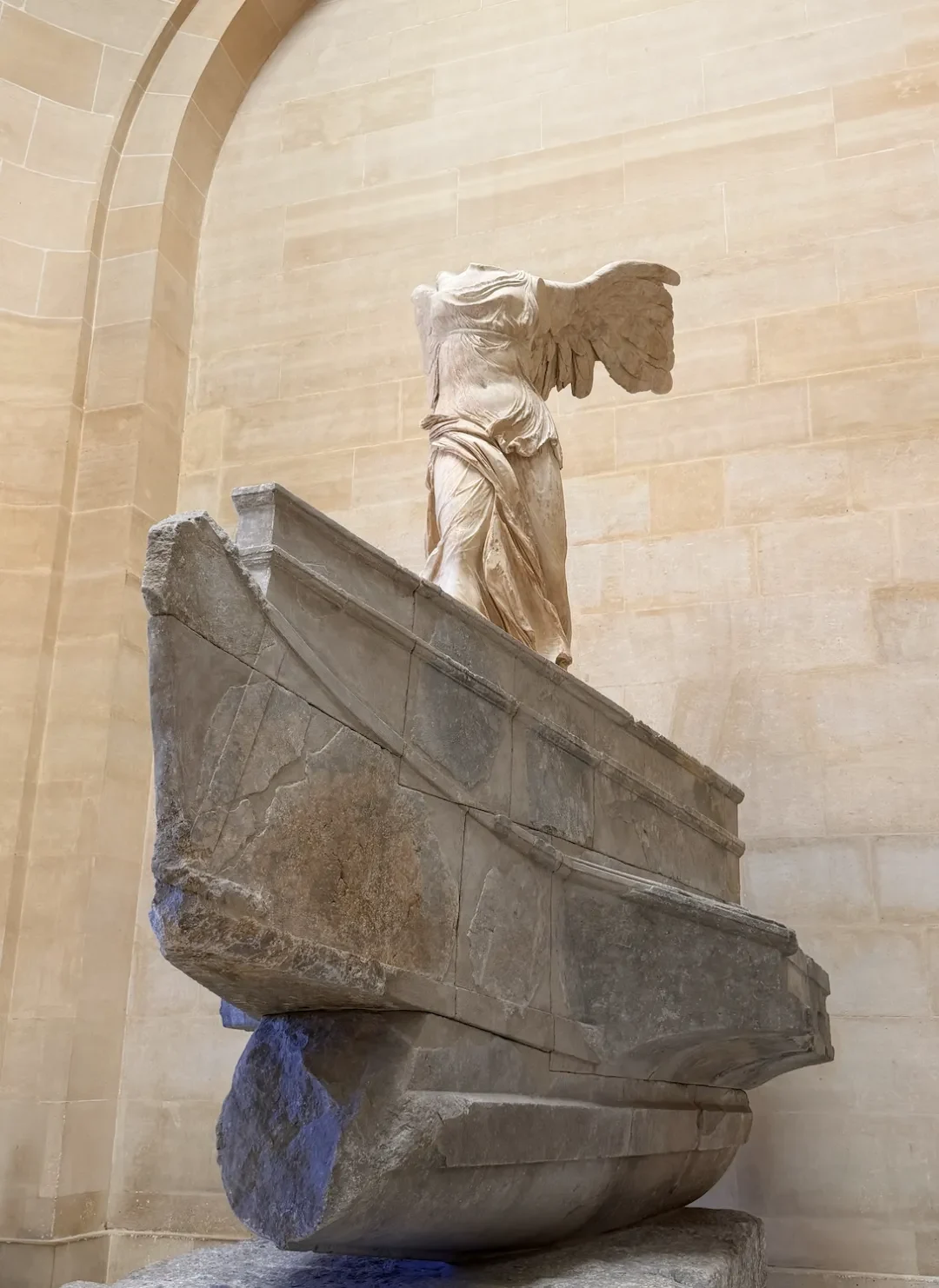
The sculptor did not carve the wind, yet every fold becomes evidence of it.
This Hellenistic work was originally an offering at the sanctuary on Samothrace. It belonged to particular beliefs, victories and a community. Its position high above the staircase today gives it an almost theatrical power.
The way we look up at her is itself part of the experience.
She has no head and has lost both arms, yet her body’s direction is unmistakable. That force reminded me of Van Gogh’s flowers in Amsterdam, where movement likewise seemed unable to settle. One artist organised sea wind through stone; the other organised life’s restlessness through paint. Different materials, yet each gives time to motionless matter.
The name “Victory” invites another thought. We ordinarily identify victory by results: securing a position, completing a transaction, winning a lawsuit. The goddess directs my attention instead to the posture of a body bearing force. The wind has not stopped; the body is still adjusting. Victory can also mean the ability to maintain direction against resistance. Is life not like this too—walking into headwinds and finding energy in adversity?
Before the Venus de Milo, the rhythm slows.
Her shoulders, waist and hips do not face the same direction; a shift of weight creates a subtle twist. Her upper body is smooth and luminous, while heavy, dense folds cover the lower body. Skin and fabric set each other off. The body holds the possibility of movement while retaining unhurried stability. Only by moving our gaze around her do we gradually understand that balance.
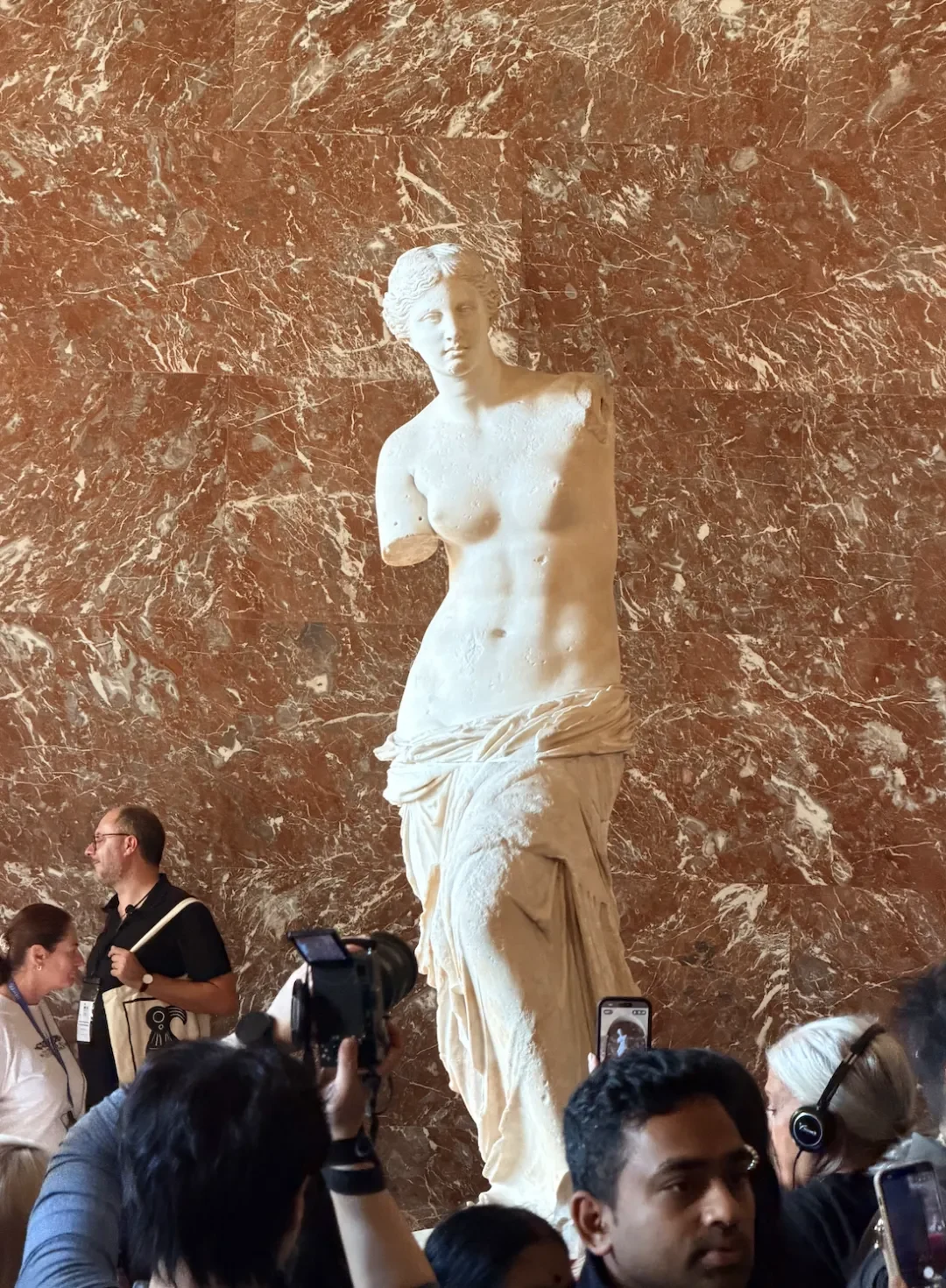
People often describe her as “the beauty of incompleteness”. But incompleteness was not the artist’s intended effect. She once had both arms and a specific gesture. Our appreciation today includes both ancient creation and subsequent historical loss.
Here I suddenly understood anew the Ru-ware bowl stand at Boston’s Museum of Fine Arts. Its sky-blue glaze and fine crackle had shown me the beauty of restraint. Crackled porcelain and a statue’s broken arms are of course different; neither should be collapsed into the vague claim that imperfection creates perfection. Together they remind me that looking requires patience: an object’s present condition has a history of materials, making and transmission.
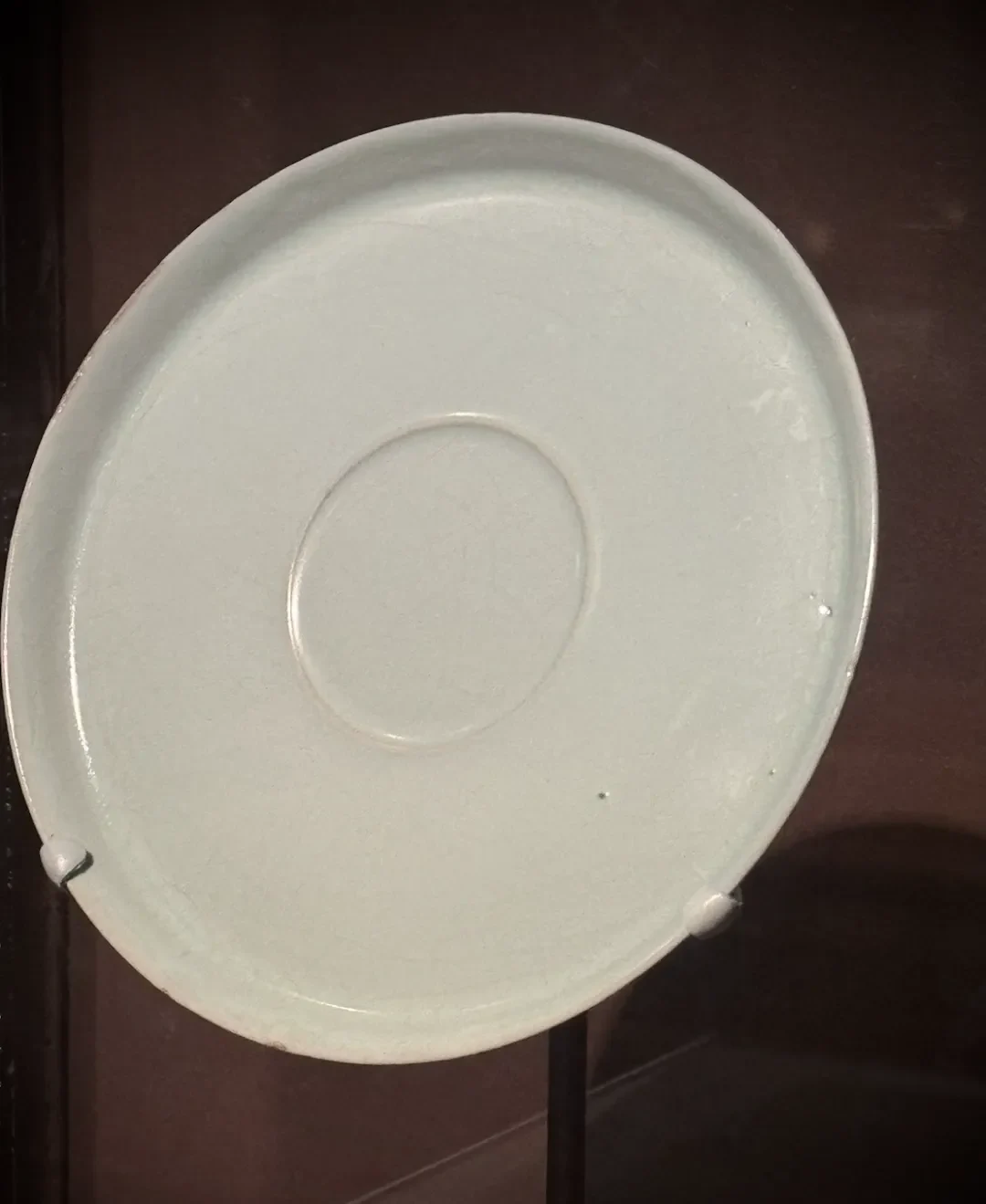
Photograph by Mingyue Gao, Museum of Fine Arts, Boston, 6 September 2025.
Life is similar. We can rebuild meaning after injury without having to praise the injury. Venus does not prove that loss is good; she makes me believe loss cannot exhaust a being’s value. This matters especially to those accustomed to planning for the future. We plan continually, hoping to make life as secure as possible. Beyond that wish, however, we need another capacity: when things fail to follow expectations, to see the relationships, responsibilities and possibilities that remain.
Leonardo’s The Virgin and Child with Saint Anne brings the question into the family.
Mary sits on her mother Anne’s lap, leaning towards the young Jesus. The child reaches to embrace a lamb while turning back towards his mother. Three generations overlap bodily while their gazes and movements unfold in layers. From Anne’s face through Mary’s inclined back to the child and lamb, the eye moves continuously through the painting.
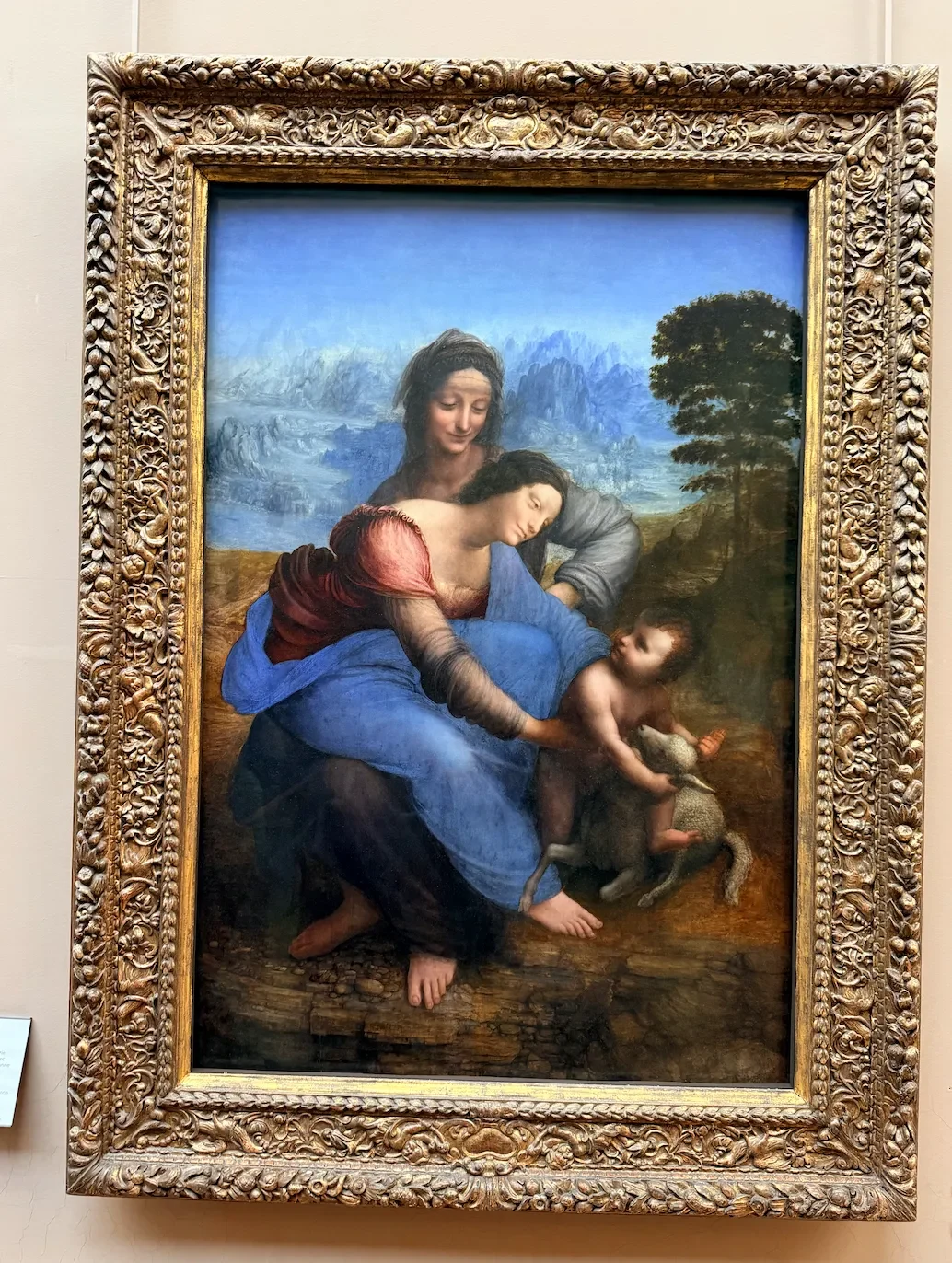
The figures form a stable triangle, but its interior is full of opposing pulls. Distant mountains dissolve into blue-grey air; the bodies nearby are soft yet substantial. Leonardo sets firm composition beside uncertain emotion, giving intimate relationships intricate layers.
The lamb is associated with Christ’s future sacrifice. Mary’s gesture therefore has two meanings: reaching to protect her child, and facing a destiny she cannot cancel for him. It seems suspended between offering and holding back.
Within its religious context, the painting concerns salvation. Within my experience, it touches the hardest part of parenthood: we give children life, but we cannot own their lives. In my years working on marriage, family and succession, I have seen much love, and also love entangled with control. Elders hope to hand down wealth, experience and even the right answers, ideally steering their descendants around every wrong turn. Yet the space the next generation needs may not fit the order the previous one designed.
The three figures are closely connected, yet each turns towards different relationships. Mary is both daughter and mother; she is supported while reaching outward. Perhaps the deepest legacy between generations is the ability to live independently. Money can support; institutions can safeguard. Another life must ultimately walk the remaining road for itself.
Looking from this painting to the Mona Lisa makes Leonardo’s understanding of people still more intriguing.
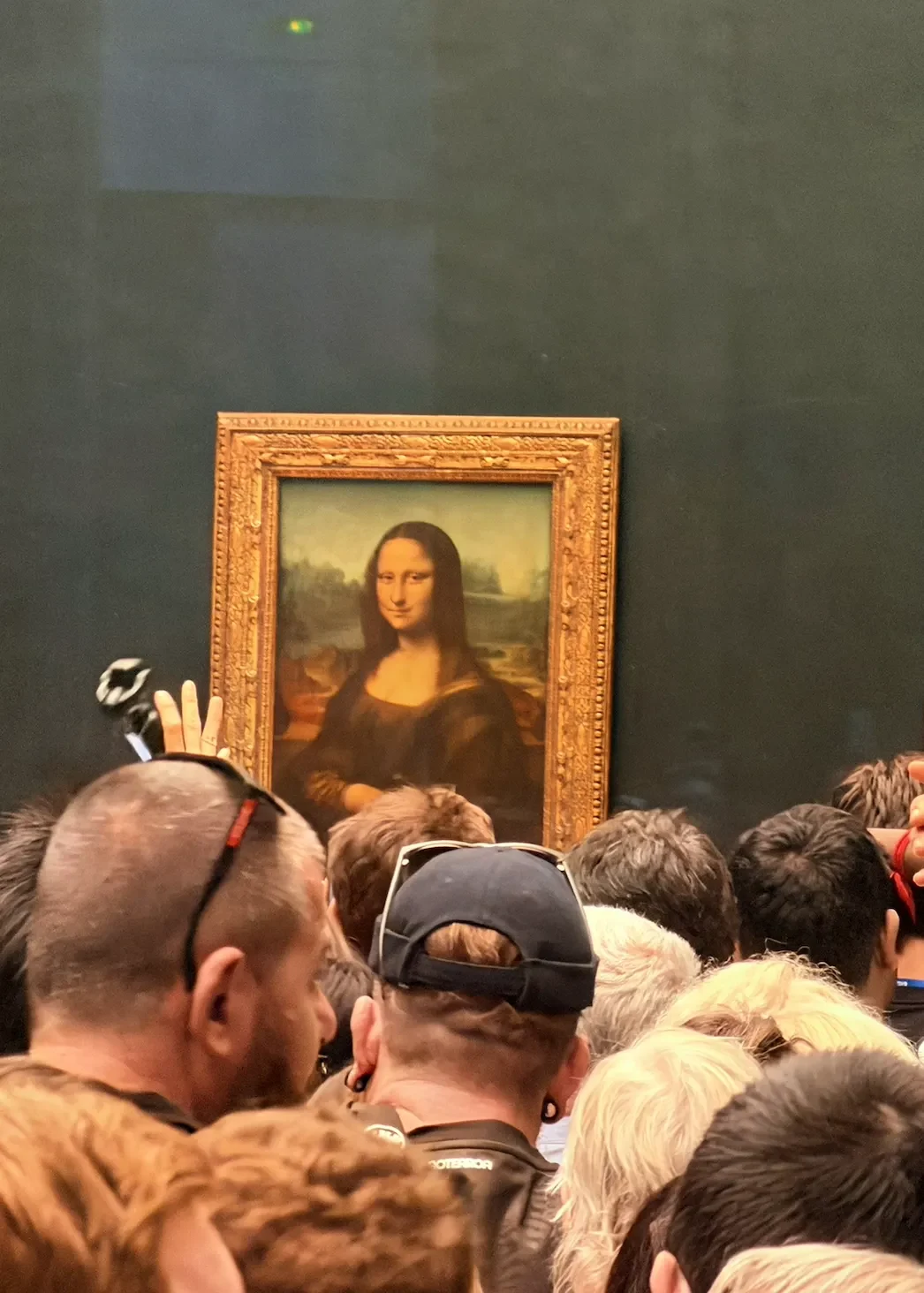
I could not push through the surging crowd; this photograph was the best I could manage.
Her hands overlap quietly, her body turns slightly and her face meets the viewer. Her clothing does not overwhelm her presence; the background opens into roads, water and rock. The corners of her eyes and edges of her lips lack sharp boundaries. Infinitesimal changes between light and shade alter her expression. This technique, called sfumato, prevents her smile from being fixed by a single definite word.
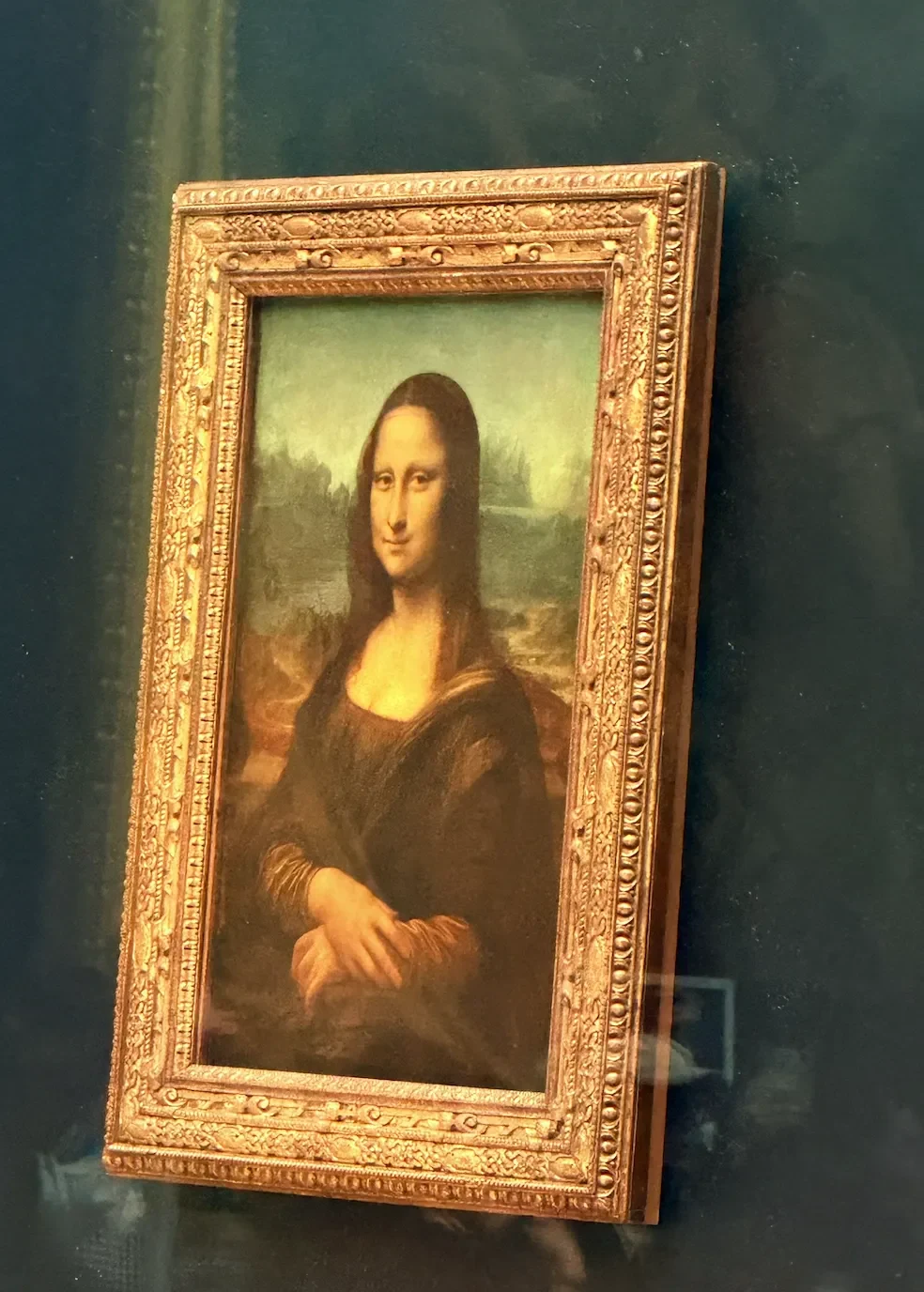
A side view, discreetly taken after slipping towards the gallery exit.
Last year, at the Mauritshuis in The Hague, Girl with a Pearl Earring offered a different encounter. She turns her head, lips slightly parted, her face and earring luminous against darkness. We sense intimacy, but cannot therefore declare who she is or what she has experienced. Both paintings seem to respond to us while retaining their distance. The girl seems just to have heard a call; Mona Lisa seems to have listened and still not decided how much to tell us. Between these gazes I thought of the limits to knowing other people. Familiarity with someone’s occupation, family and experiences does not mean we can fully explain their inner life.
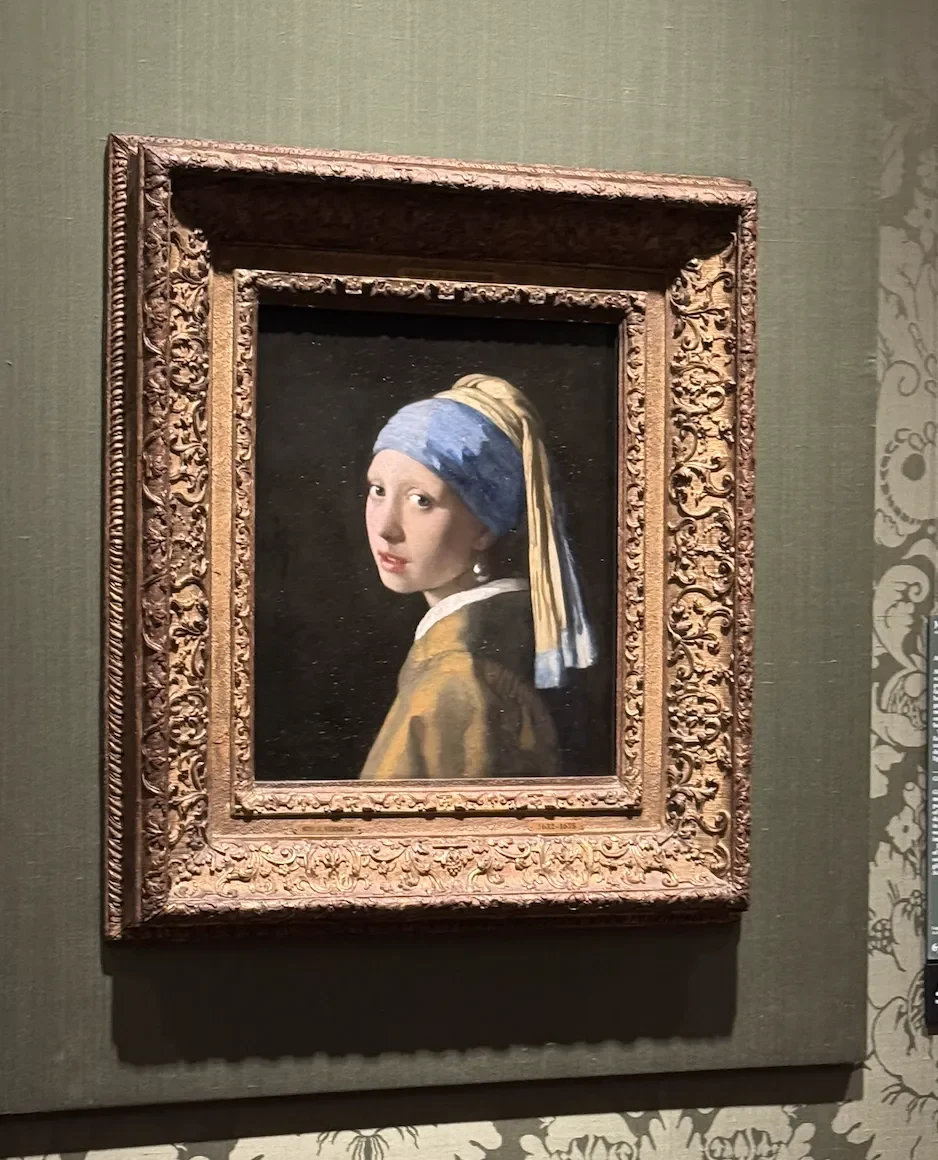
Photograph by Mingyue Gao, Mauritshuis, The Hague, Netherlands, 3 August 2025.
Legal work requires facts to be established and responsibilities clarified. That precision is indispensable. Art trains an equally necessary judgement: sometimes respecting someone includes acknowledging what we have not understood. In Van Gogh’s Amsterdam self-portraits, the brushwork seems eager to make an inner state visible; Leonardo leaves mental activity in almost imperceptible changes. Both remind me that a person’s interior has its own depth. Neither income, a résumé nor a particular success or failure can adequately describe human worth.
Opposite the Mona Lisa across the room, The Wedding Feast at Cana shifts our attention from one person’s interior to society as a whole.
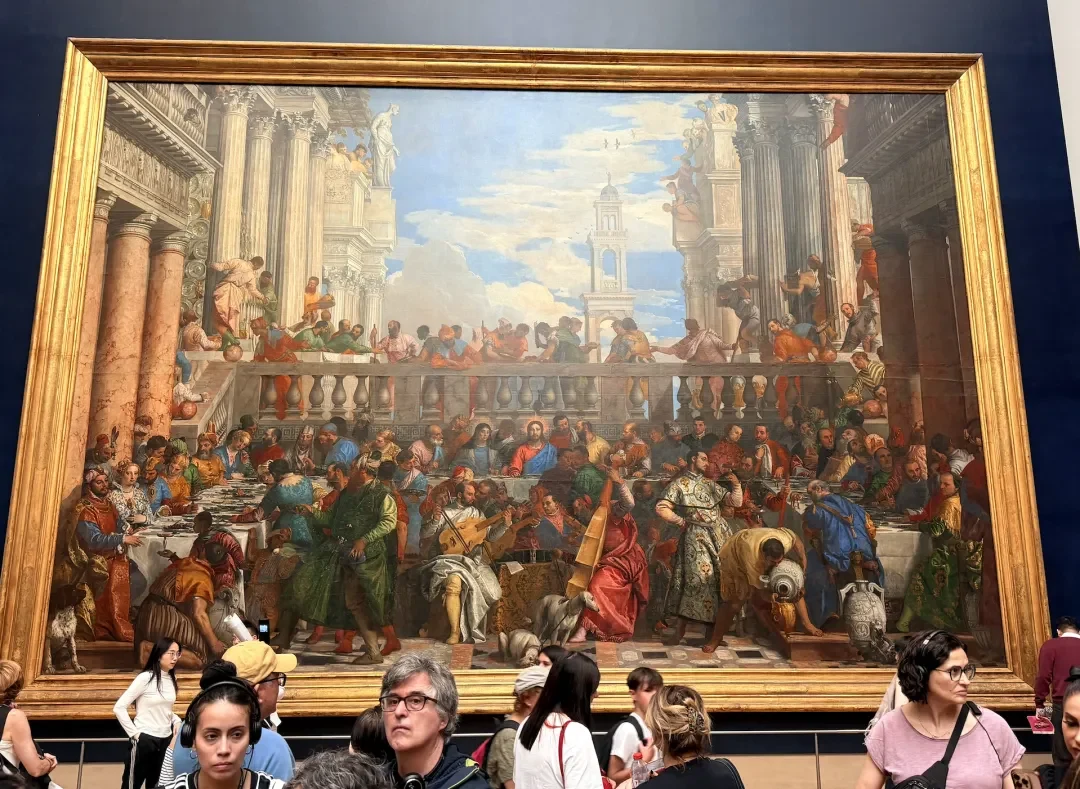
Veronese unfolds a grand architectural space, with tables, columns, balustrades and sky constructing a stage. Splendidly dressed guests, servants, musicians and vessels keep the eye moving. Silk and metal reflect different kinds of light; figures converse, bend or turn to their neighbours. The biblical wedding enters a visual world of Venetian magnificence. The wonder lies in how the distribution of activity does not quite coincide with the spiritual centre. Christ sits in the middle while the feasting continues around him. The more details we examine, the more we sense that people sharing an occasion need not recognise the same thing as important.
This recalls Vermeer’s Milkmaid at the Rijksmuseum. Working with food, vessels and human action too, Vermeer draws attention to a thin stream of milk. Veronese expands the world outward; Vermeer quietens it within a single gesture. Both give different scales of value a place in life: we need communal celebrations, and everyday labour that must not be overlooked. Thinking of Yale’s Night Café changes the mood abruptly. Red clashes with green; the floor’s perspective recedes; a billiard table dominates. People gather indoors yet seem estranged. A banquet, kitchen and café all contain people, tables and eating vessels, but their relationships differ profoundly. Material abundance does not automatically create human connection. Happiness needs sustenance and also someone with whom to share, respond and understand.
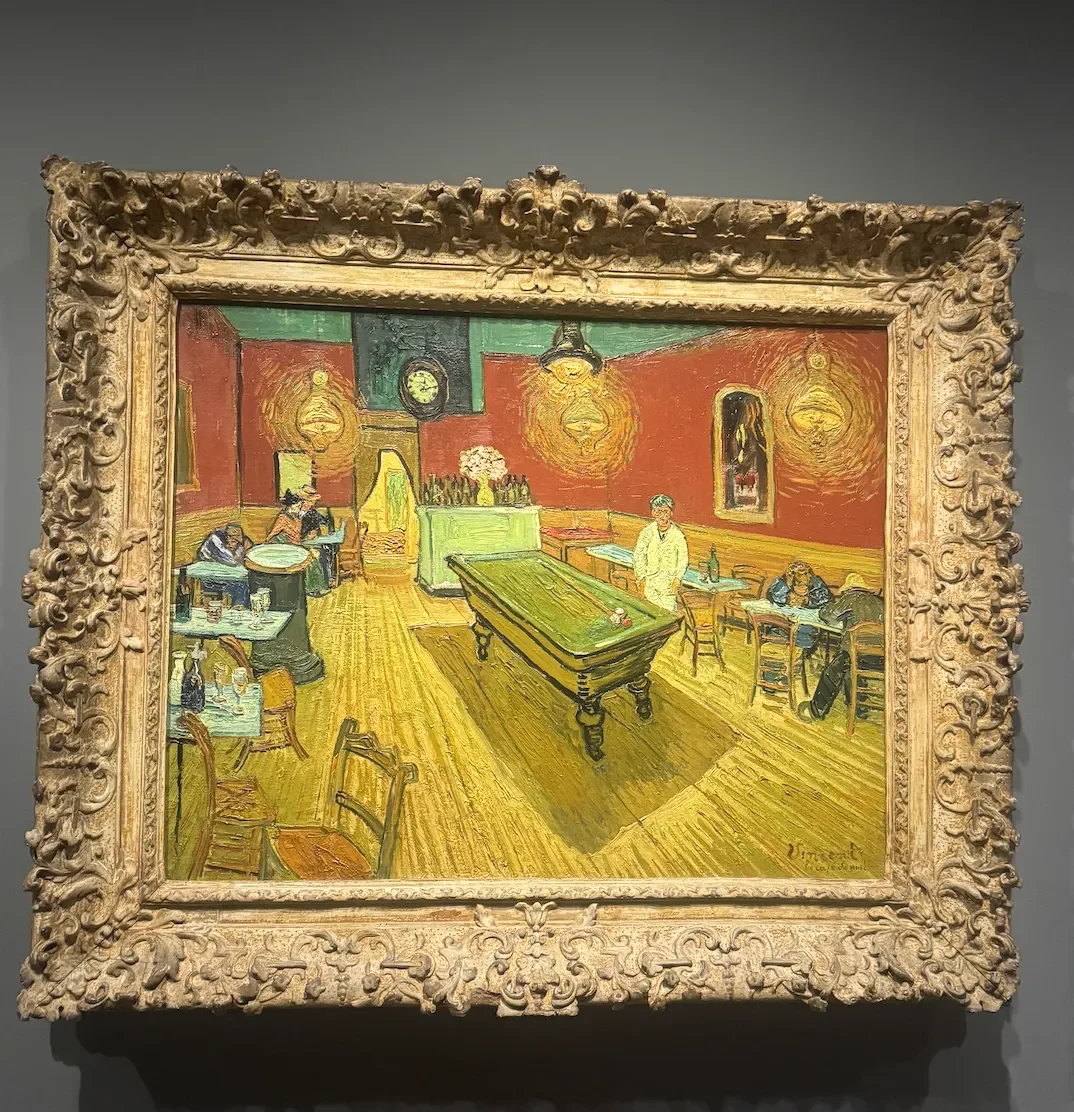
Photograph by Mingyue Gao, Yale University Art Gallery, 14 September 2025.
So when I reached David’s Coronation of Napoleon, I found it difficult simply to admire the spectacle.
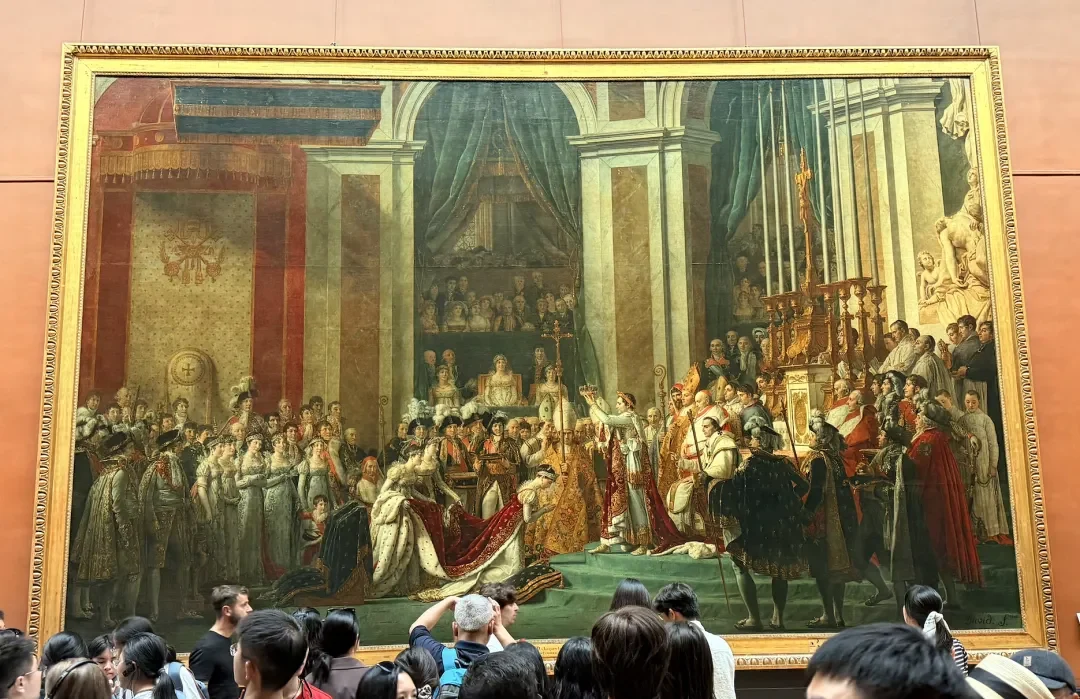
The immense painting first captures us through order. Columns, draperies and layered ranks of people form a tightly controlled space. Red velvet, white robes and gold ornament make power almost tangible. Each figure has a place; the viewer, too, seems assigned a suitable position as witness. At the centre, Napoleon crowns the kneeling Josephine. The raised crown links gesture, gaze and ritual, explaining everyone’s presence through this moment. Its persuasiveness comes from organisation. The painter integrates numerous people into one scene; even those absent in reality can enter the image the empire wishes to leave. Napoleon’s mother did not attend but occupies a conspicuous place in the painting. Art thus helps shape history. What later generations remember as “that day” may owe much to arrangements made jointly by artist and patron.
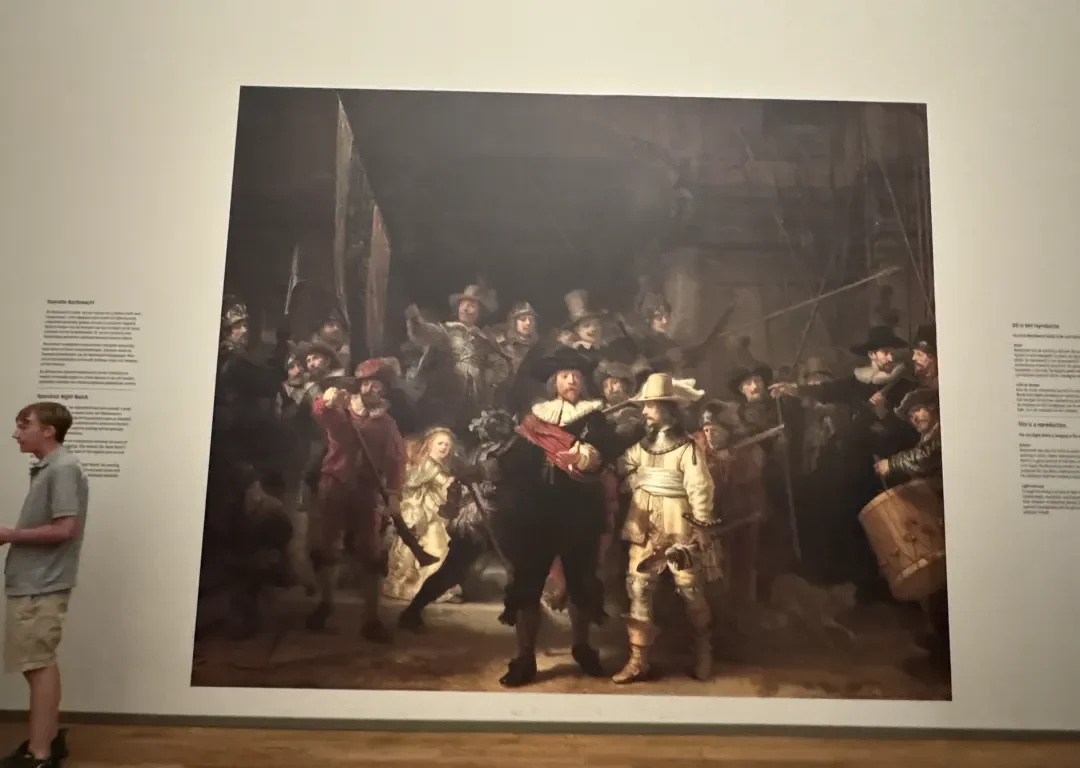
Photograph by Mingyue Gao, Rijksmuseum, Netherlands, 2 August 2025. The original was undergoing conservation; a large reproduction was displayed.
I thought of Rembrandt’s Night Watch at the Rijksmuseum. He too faced people with status and expectations, yet used light, movement and obstruction to turn a group portrait into impending action. Group portraits always allocate positions: who is illuminated, who stands at the centre, who may represent the whole? Here art history meets institutional history. We must look not only at what an image presents, but at how it makes an order seem credible. Such alertness is familiar to a lawyer. As a philosophy of life, it also carries a personal meaning. We edit our own “coronation pictures”, placing success centrally while moving chance assistance and the cost of failure to the edges. Eventually, we may even believe life arose entirely from our own will.
The Raft of the Medusa almost tears that confidence out by the roots.
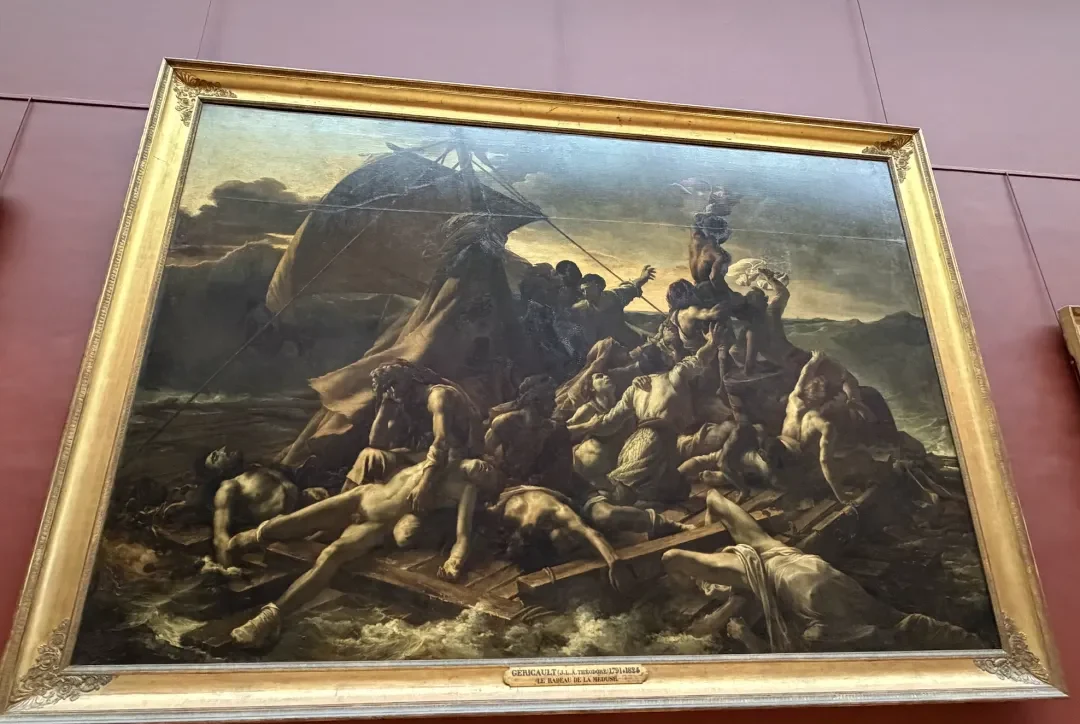
Géricault gives the viewer no stable ground. The raft tilts at sea; exhausted bodies lie across the foreground, arms and heads hanging heavily. The eye rises through those who can still stand to the figure waving a cloth, while the distant ship is barely a brushstroke. Whether it will respond remains suspended on the horizon. The composition raises hope, while waves, dark clouds and bodily weight pull us back down. We must see both what people have suffered and what they still await. Based on a real shipwreck in 1816, it involves dereliction of duty, the allocation of rescue resources and the abandonment of victims. The painter gives anonymous sufferers the monumental scale usually reserved for heroes and places a Black man high in the scene, signalling for help.
Seen alongside the Coronation, it is especially disturbing. Both are monumental: one makes power’s centre visible; the other makes those abandoned by power visible. The idealised bodies of Greek sculpture still echo here, but muscle and strength no longer guarantee destiny. Even the strongest body needs water, food, help and an order willing to accept responsibility. Endurance in hardship is precious, but some suffering demands questions about specific responsibilities. At the Getty and Huntington, I asked how institutions could keep wealth useful beyond its owner’s life. Before this raft, the question becomes urgent: when institutions fail, who first loses protection? How much of survival depends on conditions we cannot supply alone? The painting offers no easy hope. The person waving does not know that the ship will come, yet still stands. The action moves us precisely because its outcome is not guaranteed.
Finally, before Liberty Leading the People, upward movement reappears.
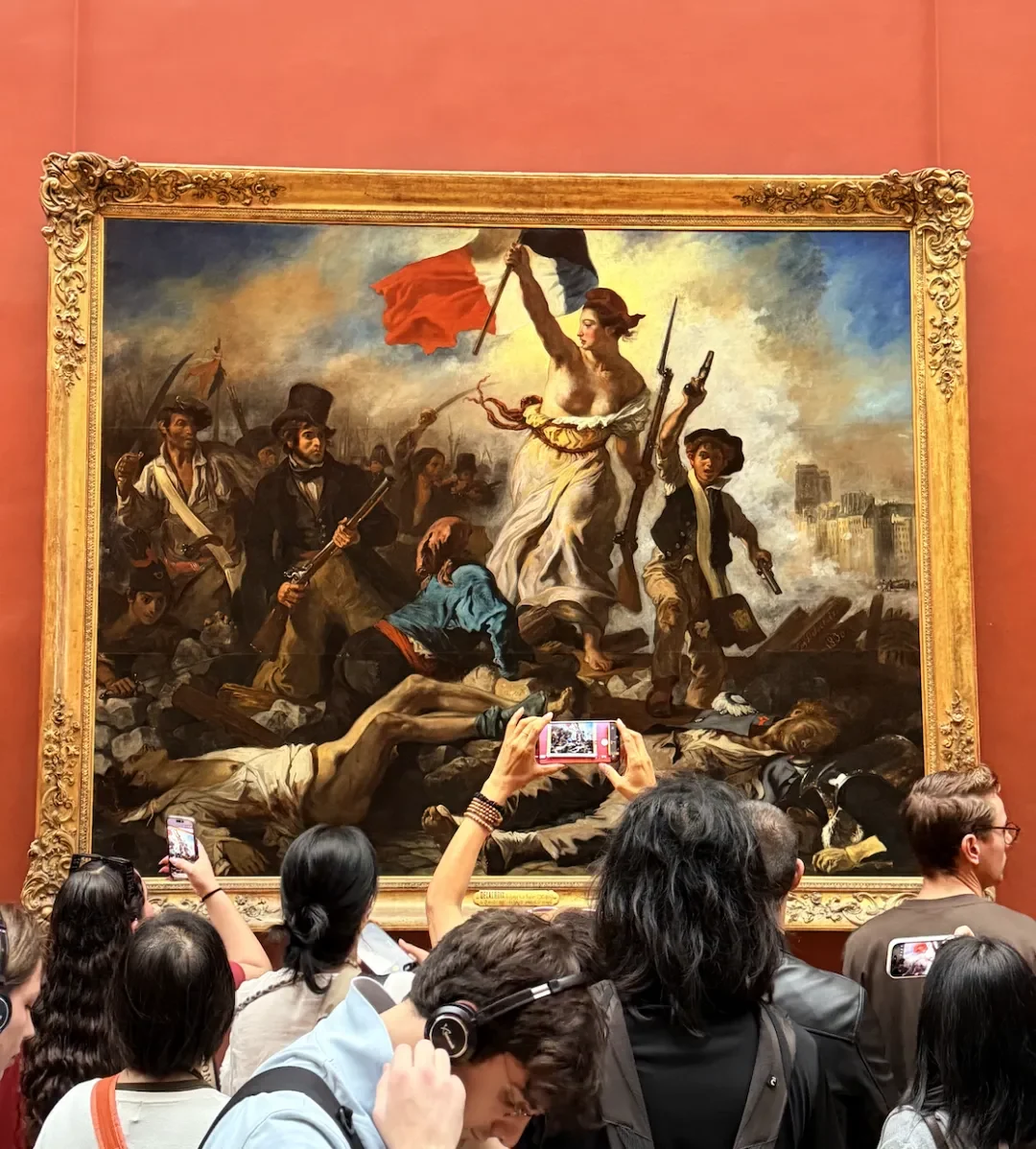
Delacroix raises the tricolour above smoke and dust. Liberty moves barefoot forward, turning to call those behind her. Her form belongs to classical allegory, yet she stands on an actual barricade. Those around her wear different clothes and move out of step. The dead in the foreground ensure that the advance carries weight. The painting refers to the July Revolution of 1830. Blue, white and red respond to each other within a grey environment, bearing political meaning and directing our eyes. Looking at her, I remembered the Winged Victory on the staircase. Both female figures lead our gaze forward and bear force in their bodies. In Delacroix, however, ideals must pass through streets, conflict and casualties to enter history.
At Amsterdam’s Sexmuseum, cultural expressions of bodies and desire made me consider freedom and boundaries. At New York’s Guggenheim, following the spiral past Rashid Johnson’s work, I thought about how individuals face historical pressure. Here freedom acquires a clearer public dimension. Individual choices must coexist with others’ lives and require lasting institutional protection. Flags can gather people, but the life that follows is longer. How different people coexist, how the vulnerable are protected and how dissent finds expression will not resolve themselves in one inspiring moment. Personal freedom also has an aftermath. After choosing, we must bear the consequences and discharge the resulting responsibilities. Freedom’s weight lies in responsibility for free will—in obligations no one else can assume for us.
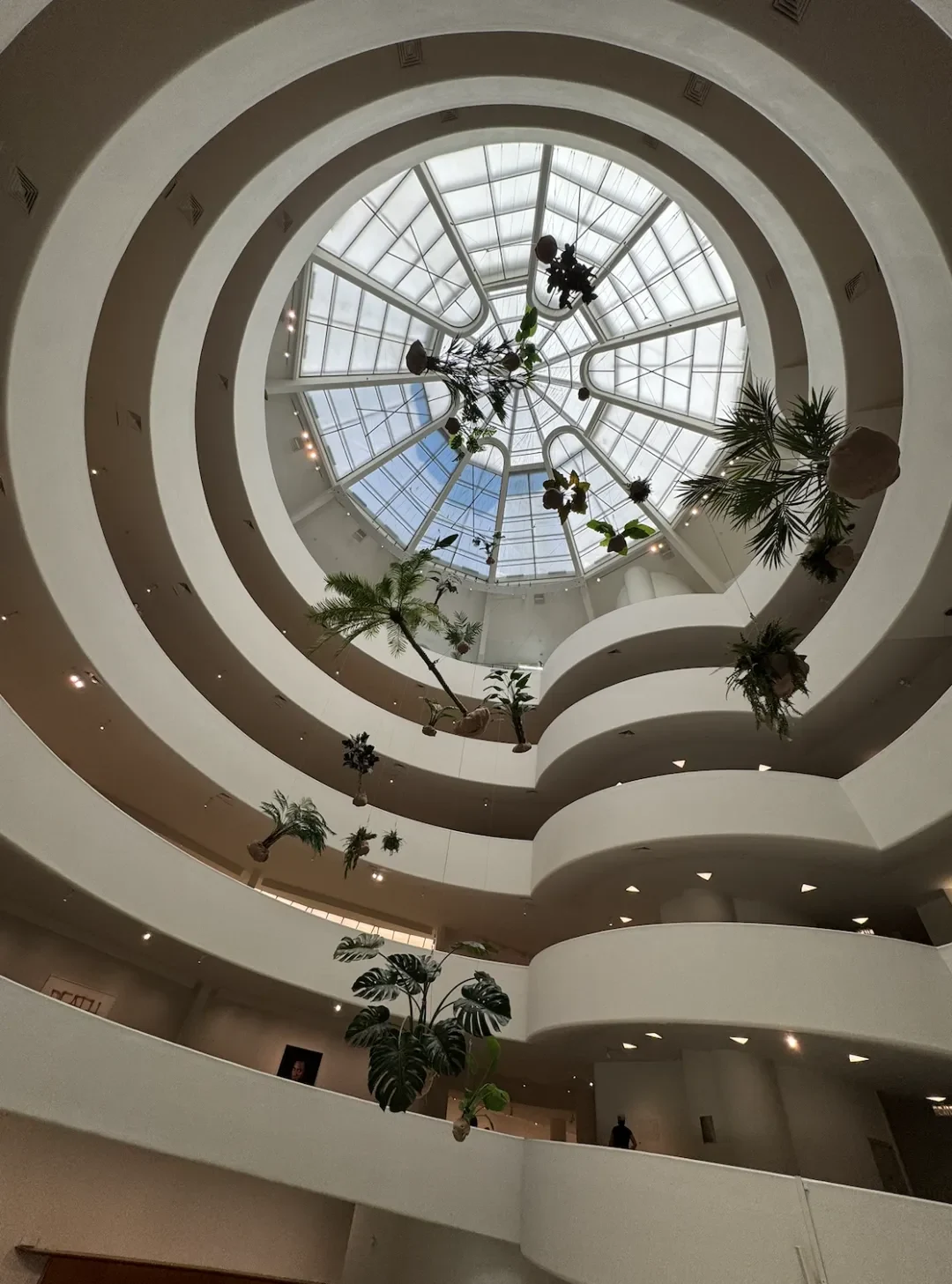
Photograph by Mingyue Gao, Guggenheim Museum, New York, 1 October 2025.
Looking back, these eight works offered no tidy set of answers. Winged Victory conveyed the force of action; Venus reshaped my understanding of loss. Saint Anne and Mary brought intergenerational support and letting go to mind; Mona Lisa preserved an inexhaustible interior. Cana’s wedding showed the richness of shared life; Napoleon’s coronation exposed the relationship between image and power. The Medusa’s raft forced me to confront vulnerability, and Liberty led vulnerable people back towards action.
The works also illuminated earlier journeys. Porcelain in the Palace Museum and Boston, flowers in Los Angeles and Amsterdam, light beside the Hague girl’s ear, unsettling colour in a New Haven café—all entered this encounter. As journeys accumulate, perhaps what matters is how one’s gaze changes: from recognising masterpieces to noticing form; from admiring genius to asking about its world; and from another person’s world back to how we ourselves should live.
Studying wealth succession, I often face an unavoidable fact: human life has a limit, while human arrangements aspire to extend beyond it. Art preserves that wish and continually revises it. Napoleon could commission a vast painting, but not dictate posterity’s judgement. A collector can own a work, but not monopolise its future meanings. Parents can leave property, but cannot live their children’s lives. What is passed on needs continuing care, interpretation and use. Generations of trustees, conservators, researchers and visitors give “eternity” a concrete, modest meaning: someone cherished it, so it was not lost; someone continued it, so it is still happening.
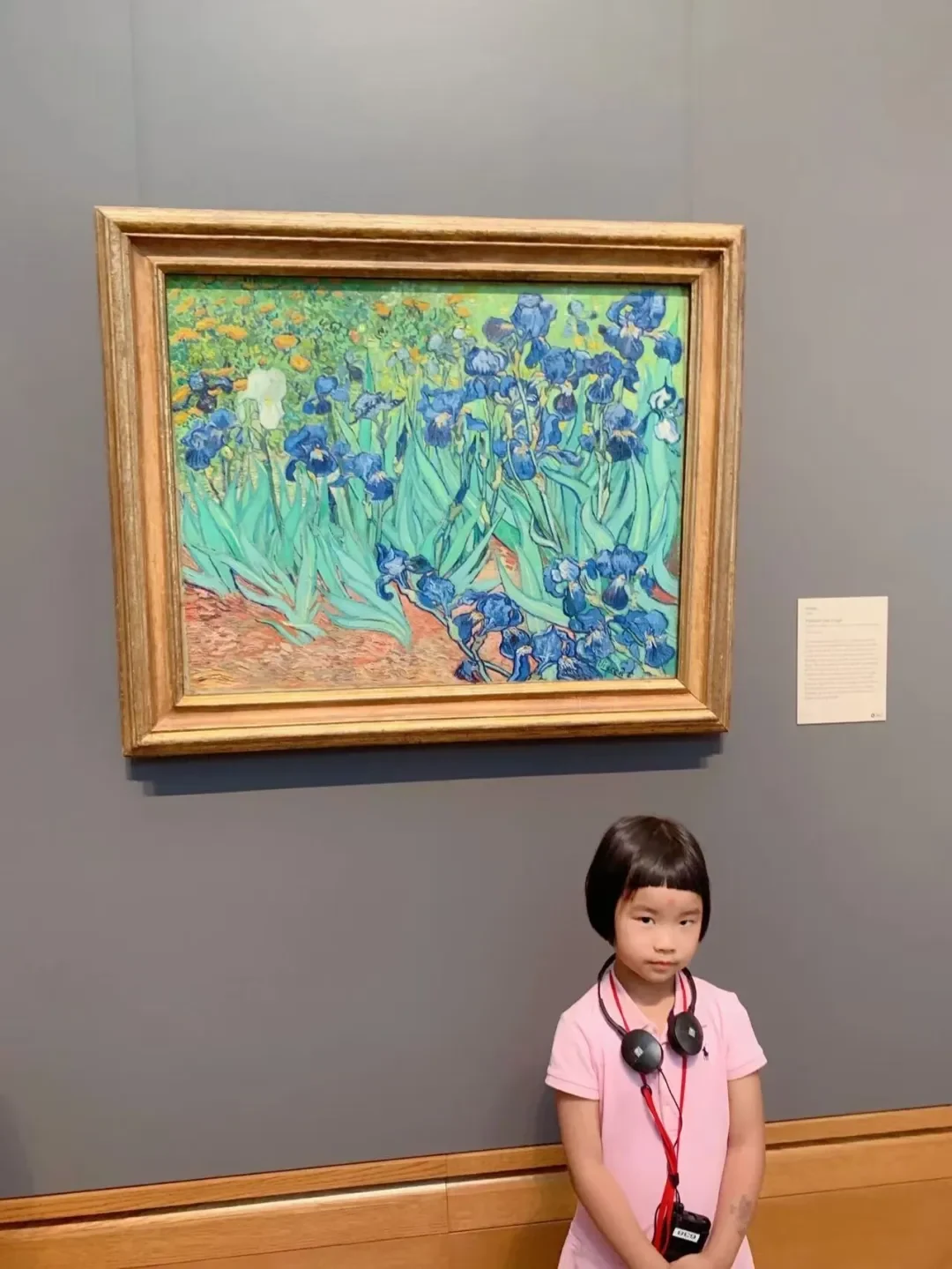
Photograph by Mingyue Gao, J. Paul Getty Museum, Los Angeles, 6 July 2019.
Remembering my daughter before Irises in 2019, I still feel that she and the painting are priceless. Today I would go one step further: a painting needs preservation; a child needs to grow. Different beings require different forms of care. I photographed the Louvre’s works and took away their images at that moment. They left me a reminder still to be put slowly into practice: take our finite lives seriously, and also those things that will outlive us; arrange the future as well as we can, while leaving room for those who follow.
Many years from now, others will come and stand where we once stood. We will not know them; they will know nothing of us.
Yet perhaps a fold of cloth, a pair of eyes or a hand reaching into the distance will still make them pause. End.