English translation of the Chinese original. Original illustrations are retained, including text within images. Translation and web presentation: 7 October 2026.
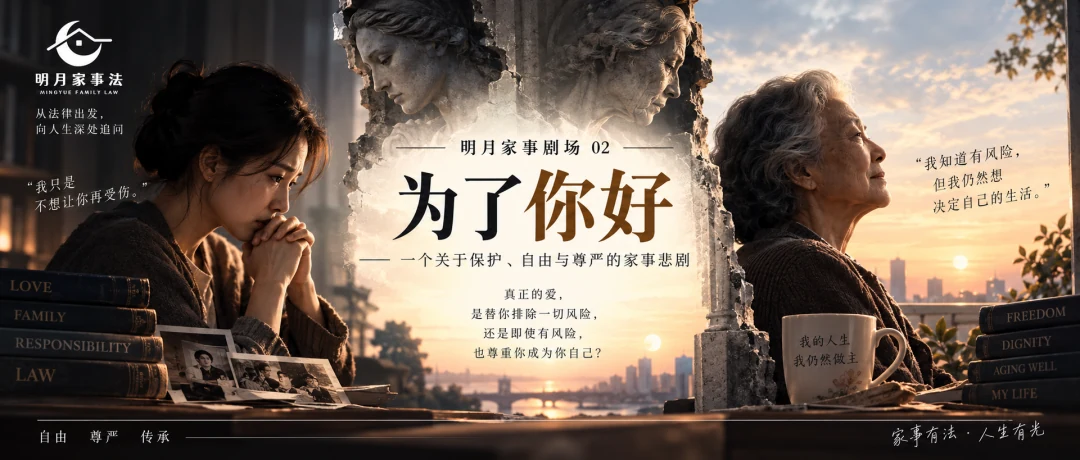
For Your Own Good
A family tragedy of protection, freedom and dignity
Mingyue Gao’s note: We often say, “It’s for your own good.” But who should define what “good” means?
Act I: Absolutely Not
At 2:17 a.m., Shen Qinghe’s phone rang.
A Shanghai hospital was calling. “Are you Shen Rulan’s daughter?”
She sat bolt upright.
Her mother had fallen. More precisely, she had fallen in the bathroom around eleven. Only three hours later did a neighbour hear intermittent cries and ask building management to open the door.
When the ambulance arrived, seventy-eight-year-old Shen Rulan was still on the bathroom tiles with a fractured hip.
Qinghe took the earliest flight from Beijing to Shanghai. Her mother’s initial examinations were complete by the time she arrived.
The doctor took her aside. “This isn’t the first time, is it?”
“The second.”
“Is she still living alone?”
“Yes.”
The doctor paused.
“After this operation, that probably cannot continue.”
Qinghe nodded.
She did not need to be told.
Countless times over the past year, she had urged her mother to move to Beijing and live with her.
Unwilling? Then a retirement community.
Unwilling again? At least a live-in carer.
Her mother always answered: “I can manage.”
This time, Qinghe decided there would be no more discussion.
Rulan had just woken when her daughter sat beside the bed. “Mum, you cannot live alone after discharge.”
Her mother glanced at her. “I’m going home.”
“You can,” Qinghe said. “But someone must be with you around the clock.”
“No.”
“Then a retirement community.”
“I’m not going.”
Qinghe lowered her voice. “Mum, you lay in that bathroom for three hours.”
Rulan said nothing.
“What if the neighbour hadn’t heard?”
Silence.
“What if you’d hit your head?”
Silence.
“What if next time it’s longer than three hours?”
Her mother turned towards the window. Eventually: “I know.”
“You don’t,” her daughter interrupted for the first time. “This is not negotiable.”
Her mother slowly turned back. “Why is my own life not negotiable?”
Qinghe looked at her and said only: “Because it’s for your own good.”
Act II: Home Again, but No Longer in Charge
The operation went well.
A month later, Rulan returned to the modest former public-housing flat in Shanghai where she had lived for over forty years. She and her husband had lived there together. Her daughter was born there. Photographs of her younger self and classmates hung on the wall. Her husband’s books filled the shelves. Among the flowers on the balcony was a plant he had grown.
She always said: “I want to grow old in this home.”
Qinghe ultimately respected that wish and did not send her to a care home. But she made other arrangements: a live-in carer, bathroom rails, slip-resistant flooring, safer appliances replacing the gas stove, a smart door lock, cameras in the living room and entrance, a limit on individual bank-card payments and location tracking on her mother’s phone. Her mother had to be accompanied whenever she went out.
Every arrangement was reasonable, even thoughtful.
Qinghe finally felt a little reassured.
Until one day, I received a call from Rulan.
“Mingyue, when are you free?”
“What’s happened?”
“I’d like to invite you for tea.”
I visited her. Years earlier, after her husband died, she had consulted me about a will, care and future guardianship. She had been in good health then, and we had kept in touch.
This time, she looked much older. She needed a stick but still spoke clearly. She did not immediately discuss her daughter. First she poured tea, then pointed towards a corner. “See that?”
I looked. A camera.
She smiled. “My daughter knows when I get up, go out and come back every day. Yesterday I wanted to buy something, but the carer wouldn’t let me go. She said Qinghe had told her not to let me out alone.” She picked up her phone. “The other day I wanted to transfer twenty thousand yuan to a former student. I couldn’t. Only then did I discover the limit on my card.”
“Did your daughter discuss these things with you?” I asked.
She thought. “Some she discussed. Some she announced.” After a pause: “I know why she does it. She’s afraid something will happen to me.”
Then: “Mingyue, is she caring for me, or taking me over?”
I did not answer immediately. Sometimes the boundary between those things is not clear.
Act III: If Something Happens to You, What About Me?
After learning of our conversation, Qinghe visited my office. She seemed angry, but mostly exhausted.
“Mr Gao, I know what Mum told you. She thinks I control her. But do you know what this year has been like for me?”
I did not interrupt.
“The first fall, I came back overnight. The second, she lay on the floor for three hours. The hospital needed my signature. I stayed through surgery, found carers, contacted rehabilitation doctors. When she refused home help, I had to persuade her, one step at a time.”
Her eyes reddened. “I daren’t silence my phone at night. Whenever it rings, my first thought is: has something happened to Mum again?”
She paused. “If I do nothing and she falls and dies at home, won’t everyone ask why this daughter did nothing for her mother?”
I had no answer. She was not wrong.
“Mum keeps saying it’s her life. Fine, I accept that! But if she falls, who takes her to hospital? If she’s unconscious, who signs? If she’s paralysed, who cares for her? If she really dies at home—” She stopped. Much later: “I’ll spend my whole life asking why I didn’t stop her.”
Then she said something I never forgot: “Of course she can choose freedom. But if her freedom ends in death, what am I supposed to do?”
It was my turn to fall silent.
We often say everyone should take responsibility for their own life. But can responsibility ever stop with ourselves? Risk can travel along family ties. Rulan bears the physical risk. Qinghe may bear another: if something happens to her mother, will she ever forgive herself?
Act IV: A Paper from Five Years Ago
Things changed when Qinghe asked: “If Mum keeps deteriorating, shouldn’t I take charge of her affairs?”
She was seriously considering future guardianship. Instead of answering immediately, I found a document from five years earlier, when Rulan’s husband had just died and she first thought seriously about old age.
We had discussed care, wills and who might help her decide if her abilities declined. Afterwards, she signed a “Statement of Wishes for Later Life” in my office.
I handed Qinghe a copy. On the second page, she read: “If age makes me slower or affects my memory, please do not assume I have lost the ability to decide my own life merely because my choices differ from yours.”
She stopped, then continued: “I know living alone may mean falls, illness going unnoticed, even death. If I can still understand those risks at that time, I hope I will be allowed to take them.”
Qinghe put it down. “When was this written?”
“Five years ago.”
“Of course she said that then. She was healthy. It’s easy to talk about freedom when you’re healthy. Is it the same after three hours on a bathroom floor?”
That was an important question, and I did not evade it. “What we need to assess now is not whether your mother five years ago could decide for her present self, but whether she can understand what this decision means today.”
“And if she can?”
“Her views still deserve serious consideration.”
“Even if the decision carries risk?”
“Yes.”
She was silent for a while.
Then: “So I’m supposed to watch something happen to her?”
“No.”
“Then what should I do?”
I thought for a long time. “Protect her. But do not make her someone without choices in the name of protection.”
She said nothing.
She took the copy of her mother’s statement when she left.
Act V: Do You Still Think We Should Respect Her Choice?
Later, mother and daughter reached an imperfect compromise. Rulan stayed home with daytime help. Bathroom rails and emergency-call equipment remained. Qinghe lifted some unnecessary restrictions, raised the bank-card limit and kept a camera only at the entrance, away from the main living areas. Her mother could walk alone, provided she carried her phone.
Neither truly wanted this arrangement, but life is often like that. Rather than resolving a problem, it lets two values that cannot be fully realised together live temporarily under one roof. Months passed without incident. Rulan went alone to the park and market, sometimes taking a bus to see friends. She seemed much brighter than just after discharge.
Qinghe gradually relaxed. Then, one winter night, the phone rang again. Her mother had fallen in the bedroom, injuring her femur again, with other complications. This time it was much more serious. When I reached the hospital, Qinghe sat alone outside emergency. She neither cried nor shouted. “Mr Gao, do you still think we should respect her?”
I stood without answering. Any answer seemed glib. If I said “Of course”, what about the woman in the resuscitation room?
If I said “We should have restricted her”, what became of all our talk of freedom, dignity and agency?
Lawyers are accustomed to seeking answers. But some questions admit legal principles without allowing the law to erase their costs. That night I understood again: respecting a choice can mean accepting a bad outcome. Perhaps that is one of the hardest parts of love.
Act VI: Who Defines “Good”?
Rulan woke, weaker than before. The doctor warned that further falls remained a serious risk. Qinghe kept watch for several nights. They spoke little.
One evening, her mother asked: “Qinghe?”
“Yes?”
“You were terrified that day, weren’t you?”
Her daughter did not answer at first. Then: “Of course.”
Her mother nodded. “So was I.”
It was the first time Qinghe had heard her admit fear.
She was not unaware of the risks, nor unafraid of death.
She simply did not want fear to decide the rest of her life.
“I know everything you do is for my good.”
Her daughter looked down.
“But Qinghe, have you ever asked yourself something?”
“What?”
Her mother looked at her. “Who defines good?”
Qinghe raised her head.
“You think being safer and living longer is good. That’s not wrong.”
“But I think being able to choose when to get up, what to eat, where to go, whom to see and how to spend my money is good too. You’re afraid I’ll fall. So am I. But I’m more afraid that one day, while I still know who I am, everyone else will begin deciding for me.”
Qinghe cried. “But what if you really die?”
Silence filled the room. Her mother took her hand. Much later: “That is a consequence I must bear.”
Qinghe shook her head. “No. You won’t be the only one bearing it.”
This time, her mother did not argue. Her daughter was right too.
After a long time, Rulan said: “Then could we each give a little?”
On discharge day, the doctor asked again: “Will she still live alone?”
Qinghe looked at her mother, who looked back. Neither answered immediately. The story ends here. I will not answer for them.
Epilogue
Later, I reopened the statement Rulan had left five years earlier. Its paper had aged. A line I had read many times suddenly felt different: “If I can still understand the risks, please allow me to take them.”
After years in family law, I have noticed how readily we define happiness for older people. Our reasons seem compelling: fear of falls, fraud, waste, the wrong companion, a decision they will regret. So we hold their bank cards, decide where they live, whom they see and when they go out.
Eventually we may even decide what kind of life is worth living. All this can begin in genuine love. That is why “for your own good” is so complicated. It can be the gentlest phrase in the world, or unknowingly become the most overbearing: “Because I love you, I have the right to decide for you.”
Does an older person remain, first of all, a person? If so, ageing should not automatically cancel the right to choose a life. Yet the other half of the truth also remains: we are not islands. One person’s risk falls upon those who love them.
A mother says: “I am willing to bear it.”
A daughter may answer: “But I am bearing it too.”
That is where this story truly has no answer.
The Law Behind the Story
Such situations are increasingly real in Chinese families: as parents age, how much may their children decide for them?
1. Old age does not mean losing the right to decide one’s life
Civil capacity does not automatically disappear at seventy or eighty, or because of physical frailty or declining memory. What matters is the ability to understand the nature, consequences and risks of a particular decision and form and express genuine wishes. “An older person made a choice we consider irrational” and “that person cannot make choices” are entirely different propositions. Confusing them is a particular danger in care, guardianship and wealth management.
2. Guardianship should protect, not take over a life
Guardianship serves a protective purpose, but contemporary thinking increasingly stresses that protection cannot simply mean substitution. Even as abilities decline, a person’s genuine wishes should be respected as far as possible, with help to understand information, express choices and retain room for self-determination. The aspiration should not be “I will make the safest decision for you”, but “How can I help you continue deciding within what you can understand?” This is a crucial distinction between supported and purely substituted decision-making.
3. Does freedom include the freedom to take risks?
The law cannot fully answer this difficult question. If an adult with sufficient understanding and judgment knowingly chooses to live alone, travel or manage property despite risks, can we remove that choice simply because it is insufficiently safe? Safety matters. But maximising it may leave us with a very safe person who no longer has a life of their own. Good later-life planning and voluntary guardianship arrangements must address more than “Who will decide for me?” They should also ask: “As my abilities decline, how do I want others to help me keep deciding?” These are different questions. I believe good guardianship does not take over a life; as someone needs more help, it returns that life to them as far as possible.
4. A final question
The daughter says: “It’s for your own good.” The mother asks: “Who defines good?” Neither is wrong. One defends life, safety, care and responsibility; the other freedom, dignity, agency and choice. The difficulty is not simply choosing a side. When complete safety and complete freedom cannot coexist, how much of one will we sacrifice for the other? And if freedom includes making mistakes, should it also include taking risks?