English translation of the Chinese original. Original illustrations are retained, including text within images. Translation and web presentation: 7 October 2026.
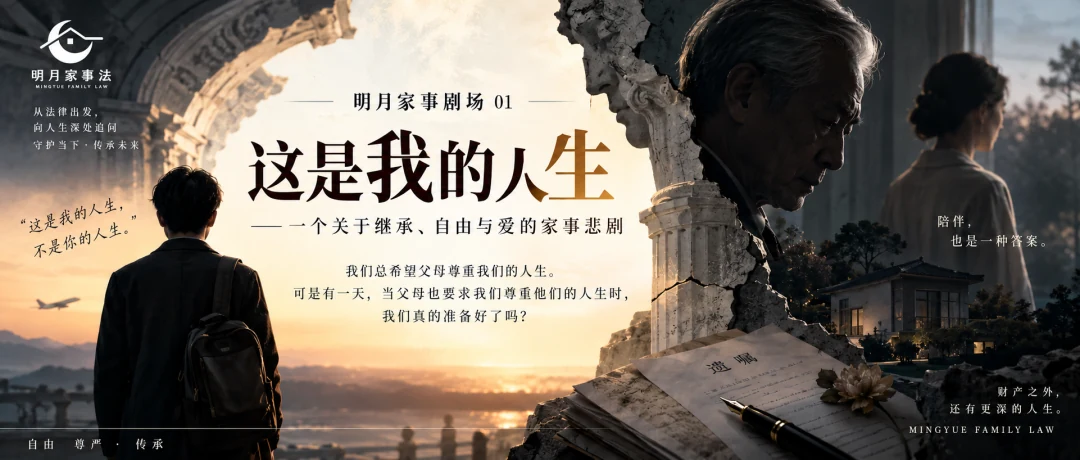
This Is My Life
A family tragedy of inheritance, freedom and love
Mingyue Gao’s note: We always want our parents to respect our lives. But when they ask us to respect theirs, are we really ready?
Act I: What Right Does She Have?
Seven days after Gu Yuanshan’s funeral, his only son, Gu Xingzhi, came to my office.
He was forty-eight, successful, and had worked overseas for years.
In a black coat, he placed his father’s death certificate, household registration documents and several title documents on my desk.
“Mr Gao, I’m my father’s only son.”
“My mother died years ago, and he never remarried. Please help me deal with the estate as soon as possible.”
I did not answer immediately.
I had known his father for eleven years.
Three years earlier, Gu Yuanshan had handed me a brown envelope.
Before leaving that afternoon, he turned back to repeat:
“Mingyue, keep this safe for me.”
“Open it after I’m gone.”
Later, he appointed me executor of his will.
Now he really was gone.
I took the envelope from the filing cabinet.
Gu Xingzhi watched me.
“What’s that?”
“Something your father left.”
I opened it.
Inside were a will and supporting documents.
The will was straightforward.
Gu Xingzhi would still receive a substantial part of his father’s property.
But the home where his father had lived for years, and some financial assets, were dealt with differently.
A name appeared in the will.
Lin Jingyi.
Gu Xingzhi stared at it.
At first, he seemed not to understand.
Seconds later, he looked up.
“Lin Jingyi?”
I nodded.
“Do you know her?”
He did not answer.
Instead, he asked:
“What right does she have?”
Act II: Father Was Already Confused
A few days later, Gu Xingzhi returned.
This time he brought medical records.
His father had indeed experienced memory loss in his final years. One outpatient record mentioned “mild cognitive impairment”.
He pushed the records towards me.
“Look, Mr Gao.”
“My father was already confused then.”
“A man in his seventies, poor health, declining memory, with a woman beside him every day…”
He left the sentence unfinished.
I understood. “So you believe…?”
“This will cannot count!” He was certain. “My father would never have arranged things like this in his right mind.”
That sentence stopped me.
I have heard many similar claims in family cases: “My father could never think that.” “My mother would never do that.” “I know him too well.”
And so on.
Yet sometimes, do we really know that person—or only our idea of that person?
I did not argue.
I simply took another document from the file.
“Record of Assessment of Cognitive Function and Ability to Express Wishes.”
The assessment had taken place close to the making of the will.
It recorded that, at the relevant time, Gu Yuanshan could understand the nature and consequences of important matters and express his wishes with reasonable consistency.
Gu Xingzhi read it twice.
Then suddenly asked:
“Who arranged this assessment?”
I looked at him.
“You did.”
He said nothing.
Years earlier, he had needed his father to sign an important authorisation concerning company business.
To guard against later challenges to his father’s capacity, he had arranged an assessment of cognition and ability to express wishes.
Then, he needed to prove his father was lucid.
Now, he needed to prove the opposite.
Between those two answers stood his own signature.
Gu Xingzhi sat there.
For the first time, he had nothing more to say.
He had come looking for evidence to overturn the will.
The first evidence he found was evidence he had created himself.
Act III: That Woman
As the capacity argument became harder, he turned to another question:
Who exactly was Lin Jingyi?
It was not an unreasonable question.
Lin Jingyi was fifty-two.
She was not Gu Yuanshan’s wife or relative and had no legal duty to support him.
Yet she had been a frequent presence in the last decade and more of his life.
Bank records were gradually assembled.
He had transferred money to her.
Paid for trips.
Provided a substantial sum towards a home she bought.
Gu Xingzhi became visibly agitated.
“Look. Doesn’t that prove it?”
“Prove what?” I asked.
“She was after his money.”
I studied the records. “Possibly.”
He clearly had not expected that answer.
“But these records cannot prove something else,” I continued.
“What?”
“That your father didn’t know she needed money.”
He paused.
Money is always the easiest thing to see in family cases.
Companionship rarely appears on a bank statement.
Later, we found more among Gu Yuanshan’s papers.
Ten years of hospital records.
Again and again, the emergency contact was Lin Jingyi.
She accompanied him for surgery.
She accompanied him for rehabilitation.
In a video of his seventy-fifth birthday, she was beside him as he blew out the candles.
None of this proved she had no interests of her own.
Of course she might have had.
An adult can care about another person and also consider her own life.
Human nature rarely divides as neatly as the two sides of a courtroom.
After reviewing the material, Gu Xingzhi said: “I admit she spent more time with Dad.”
He paused. “But I didn’t neglect him either.”
That was true too.
He had paid a substantial share of his father’s medical and living costs.
If his father needed a good doctor, he found one. If he needed money, he provided it.
He participated in important medical decisions.
But he lived abroad.
“I have a career and a family,” he said. “I couldn’t be with him every day.”
No one contradicted him.
That statement, too, was not wrong.
Act IV: An Email from Ten Years Ago
What truly changed this story was not a will.
It was a ten-year-old email.
That year, Gu Yuanshan had first developed serious health problems.
He wanted his son to return to China.
Gu Xingzhi refused.
They argued fiercely.
Afterwards, the son wrote a long email.
Most of it no longer mattered much.
Except these lines: Dad, I know you want me to come back. But I have my own family and career. You must arrange your own life; I will meet the costs I should bear. But I cannot live in the way you want me to.
Gu Xingzhi read the email again.
He looked up. “What’s wrong with saying that?”
“Nothing,” I replied.
He looked surprised.
I genuinely saw nothing wrong with the statement itself.
Adult children are entitled to lives of their own.
Loving parents does not require abandoning a career, marriage, family or personal choices.
Nor does a father have an inherent right to demand that his adult son live according to his wishes.
This was the principle Gu Xingzhi had always upheld:
An adult should have a life of his own.
I opened another file.
It was a recording his father had made years later.
The older man spoke somewhat slowly.
“Xingzhi did nothing wrong.”
Gu Xingzhi looked up.
The recording continued.
“He has his own life.”
“When I was young, I didn’t give up my career for my parents either.”
“What right have I to insist he come back for me?”
The office was quiet.
Then: “What he said was right.”
“I should arrange my own life.” A pause. “So I will arrange my own care in old age.”
“I will decide who keeps me company. And how my possessions are dealt with at the end—”
He paused. “That should be my decision too.”
The recording ended.
No one spoke.
Ten years earlier, the son had claimed his freedom with “my life”.
Ten years later, the father had not rejected those words.
He had simply applied the same principle to himself.
Act V: Did He Stop Loving Me?
After that day, Gu Xingzhi did not contact me for a long time.
When we next met, he no longer discussed the will’s validity.
Not at first, anyway.
He sat down and asked a different question.
“Mr Gao.”
“Was Dad blaming me all along?”
I did not answer.
A lawyer cannot easily answer such questions for someone who has died.
But Gu Yuanshan seemed to have anticipated this day.
He had left one final video.
On screen, he looked noticeably older.
He spoke slowly:
“If Xingzhi sees this one day, I want him to know something.”
“I never blamed him.”
“He is a good son.”
Gu Xingzhi lowered his head.
His father continued:
“Parents who love their children should not ask them to repay that love by giving up their own lives.”
A pause.
“But children who love their parents should not ask them to prove their love by giving up their lives either.”
“I am not leaving property to Jingyi to punish Xingzhi.”
“Xingzhi is my son.”
“Jingyi walked another stretch of life beside me.”
“Those are two different things.”
The recording was nearly over.
Gu Xingzhi kept his head bowed.
Much later, he said: “But I’m his son.”
I looked at him.
I knew how much lay unspoken behind those words.
I am his son.
His only child.
We have decades of fatherhood and sonhood between us.
Does none of that matter?
I did not try to answer those questions.
Finally, I said only: “Yes.”
Of course you are his son.
The question is what being his son means.
Act VI: This Is My Life
In the end, Gu Xingzhi still decided to challenge the will.
It was not surprising.
Feelings are one thing.
The right to litigate is another.
His lawyer also advised that, professionally speaking, the case was not beyond argument.
A few days before the hearing, he returned to my office.
Some of his father’s belongings were still being sorted.
An old photograph album lay on the desk.
He opened it casually.
Inside was a faded photograph.
A young man in his twenties stood at an airport with a backpack.
It was the young Gu Xingzhi.
On the back, his father had written: “1998. Seeing Xingzhi off abroad.”
He held the photograph for a long time without turning the page.
Then: “I remember that day.”
His father had strongly opposed his leaving China.
They had a terrible argument.
For the first time, the young man truly defied his father.
“Dad, this is my life, not yours.”
More than twenty years had passed.
The young man who said those words was nearly fifty.
The father who had not wanted him to leave was gone.
I said nothing.
I merely played his father’s final recording.
The aged voice sounded again: “This is my life.”
Gu Xingzhi still held the photograph.
A young voice seemed to reach us from the airport decades earlier: “This is my life.”
An older voice answered across the years: “This is my life.”
Between them lay an entire lifetime as father and son.
He slowly put the photograph down.
Beside it lay the litigation papers his lawyer had prepared.
He glanced at them.
Did not pick them up.
Then, after a while, he did.
The story ends here.
I do not know what he would ultimately decide in that moment.
Perhaps that was no longer what mattered most.
Epilogue
His father’s papers were eventually put in order again.
Will, medical records, bank statements, emails, photographs.
And words left for the future that he could no longer speak himself.
I returned them, one by one, to the archive box.
Its label read: “Gu Yuanshan Estate Administration.”
After years practising family law, I increasingly feel that people never leave only property behind.
Sometimes they leave a sentence unfinished years ago.
A reconciliation never completed.
A choice no one truly understood.
Or a question someone still alive refuses to face.
The law can tell us who may inherit, whether a will is valid and who ultimately receives the property.
But it cannot answer what blood ties mean, whether companionship can be measured, or whether loving someone means being entitled to everything they leave.
There is a harder question still: when another person’s choice hurts us, are we willing to acknowledge that it remains their choice?
I closed the box.
Gu Yuanshan had left this world.
Yet until the end, he seemed simply to uphold the principle his son had asserted in youth: This is my life.
The Law Behind the Story
1. Being an only child does not automatically mean receiving the entire estate
Where there is no will or other estate arrangement, heirs must first be identified under statutory succession rules. Chinese law also recognises individuals’ ability to dispose of personal property by will and appoint executors. “I am an only child” and “all my parents’ property must eventually come to me” are therefore different legal propositions. Kinship may confer eligibility to inherit; it does not give adult children an automatic entitlement to their parents’ property.
2. Cognitive decline does not automatically invalidate a will
Age, illness, memory loss and mild cognitive impairment cannot simply be equated with whether, at a particular time, someone understood what property they were disposing of, to whom, and with what consequences. What requires examination is the person’s condition when the will was made and the relevant evidence. Medical records, professional assessments, conversations, witnessing, video and consistent expressions before and after the will may all matter.
3. Executors and estate administrators do more than distribute property
Estate administration is often understood as transferring titles and dividing assets. In complex families, it has another purpose: preventing death from extinguishing lawful decisions made during life.
When testators can no longer explain themselves, preserved documents, recordings, video and evidence of how the will was made may become their final expression to the world. An estate administrator’s role should not be to compete for one heir’s interests. The administrator must attend to the estate, the law and the deceased’s expressed wishes. This is perhaps why I increasingly believe good succession planning is never only about property. It also plans how someone can continue to be heard after they can no longer speak.
3. A final question
If parents should respect adult children’s freedom to choose their own lives, should they not have the same freedom over care, companionship, affection and property in their final years? We want our parents to respect our lives. Are we truly ready to respect theirs?