English translation of the original Chinese essay. Original Chinese illustrations are retained. English reading guide and web presentation updated: 7 October 2026.
Many clients come to me with apparently specific questions.
“My mother is elderly. I want her to move in, but my wife strongly disagrees. Whom should I listen to?”
“After marriage, must my money serve only my own small household? Can I still help parents or siblings in difficulty?”
Another situation is especially common in the divorce cases I handle.
A young couple cannot afford a home. Their parents contribute decades of savings, perhaps even selling a property, to fund the deposit. Nobody seriously discusses whether the contribution is a loan or a gift. The parents simply think: “Our child is marrying; of course we should help.”
Ten years later, the marriage breaks down. When the home is divided, a very practical question appears: what exactly were those millions of yuan? Part of the couple's shared property? A gift to the parents' own child? Or help to establish a family without relinquishing every expectation attached to the money?
On the surface this is a legal issue. Beneath it lies a family relationship issue, and beneath that a philosophical question: after marrying, does a person belong first to the marriage, or still to the family of origin?
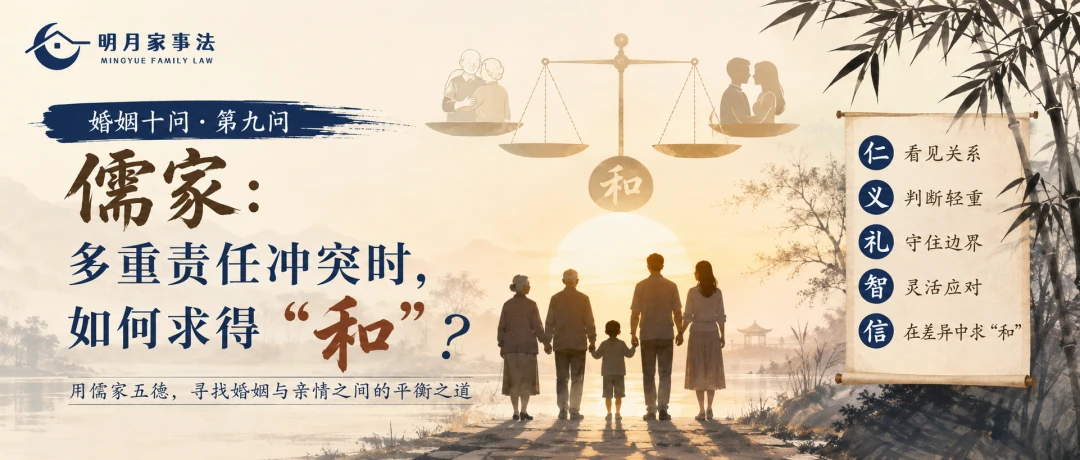
This is our ninth question. This time I return to a Chinese intellectual tradition: Confucianism.
ENGLISH READING GUIDE
Confucianism
- Consider care, responsibility and trust in daily conduct.
- Relationships call for boundaries as well as mutual obligations.
- Harmony need not mean that two people are the same.
A concise reading guide based on this essay; not a word-for-word translation of the original poster.
View the original Chinese learning poster
1. Modern marriage and the traditional family follow different logics
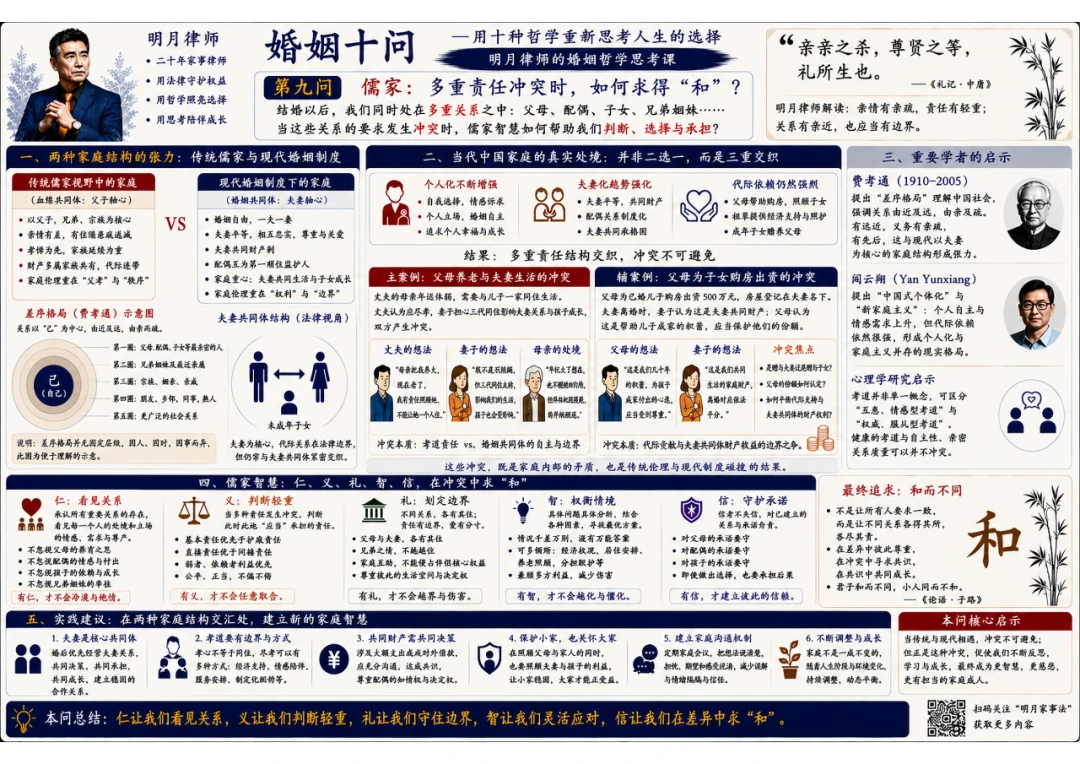
Modern people increasingly regard marriage as a matter between two people. They fall in love freely and decide whether to marry. Afterwards they share a life, accumulate property and raise children. Modern marriage increasingly emphasises equality, freedom to marry, independent personhood and boundaries within family life. Its central unit is increasingly clear: the couple.
The traditional Chinese family was not organised in quite this way. In the Confucian world, a person is never an isolated individual. Birth places us within a network: someone's child, sibling or junior relative. Marriage adds being someone's husband or parent.
Confucianism therefore begins less with “What do I want?” than with “What relationships am I in, and what responsibilities do they require?”
Early in the Analects, young people are urged to practise filial respect at home, respect elders beyond it, act carefully and faithfully, care broadly for others and draw close to the humane. The important idea is that moral life begins in relationships.
Filial responsibility concerns parents and children.
Fraternal respect concerns siblings.
Trustworthiness concerns commitments between people.
Humaneness extends from those closest to us towards a wider community.
In traditional society, marriage was therefore never an entirely independent contract between two people. It belonged to a wider kinship network. This is one of the deepest sources of family conflict today.
2. Fei Xiaotong's differential mode of association explains family complexity
In From the Soil, Fei Xiaotong introduced the differential mode of association. Social relationships resemble ripples spreading from a stone dropped into water: the self at the centre, closest relationships nearby, then relatives, friends, neighbours, acquaintances and wider society. The point is not whether there are five circles or six. Traditional Chinese relationships are not flat: they have degrees of closeness, distance and obligation. This closely accords with Confucian ethics.
The Doctrine of the Mean, within the Book of Rites, links ritual propriety to graded affection for kin and graded respect for the worthy. The key idea is that relationships differ in closeness. The question is not whether differences exist, but how to handle them appropriately.
Modern marriage introduces an important change. Once a person marries, the spousal relationship moves towards the centre of family life. The traditional pattern faces a new question: after marriage, who is closer, parents or spouse? Drawing concentric circles cannot resolve it, because modern marriage rearranges traditional relational distances.
3. Today's Chinese family is neither wholly traditional nor purely nuclear
A striking feature of contemporary Chinese families is the coexistence of stronger individual autonomy and strong intergenerational dependence. Young people insist that their lives are their own, marriage is between the couple, and parents should not interfere. Yet parents often help buy the marital home; grandparents help raise children; and adult children later shoulder elderly parents' financial, medical and care needs.
Three forces therefore coexist: individualisation, the couple as a unit, and intergenerational dependence. Many apparent spousal disputes involve two extended families. Consider the main example in our poster: an elderly mother hopes to move in with her son. He says she raised him and he cannot neglect her. His wife says she does not oppose filial care, but the home is also hers, and permanent three-generation living would fundamentally change their marriage.
Who is wrong? Both make legitimate claims. He invokes filial responsibility; she invokes the couple's autonomy and boundaries. The difficulty is not distinguishing good people from bad, but judging between two legitimate ethical demands.
4. Parental contributions to a home reveal the conflict more clearly
The tension is sharper in property matters. Many couples establish an ostensibly independent household through heavy financial dependence on parents. The paradox is that the resources creating independence may come from the preceding generation.
Parents contribute RMB 5 million to their son's marital home, registered in both spouses' names. Ten years later the couple divorce. The wife sees their shared marital home; the parents see decades of savings contributed to help their child establish a family. Law must examine gifts, the nature of the contribution, registration, intentions and evidence. Beneath this lies a sociological question: when did parental assets leave the family of origin and enter the marital unit? And a philosophical one: does giving through family affection mean rights disappear? Focusing only on the couple may overlook enormous parental contributions. Allowing financial contributions to justify continued parental intervention, however, erodes the couple's boundaries. Here traditional family ethics and modern marriage truly collide.
5. Confucianism offers more than a ranking of duties
Does Confucianism say parents must always come first, or that a spouse must always come first after marriage? I think neither. Reducing it to unconditional parental obedience understates its complexity. Five ideas deserve renewed attention: humaneness, rightness, ritual propriety, wisdom and trustworthiness—ren, yi, li, zhi and xin. They are less mechanical rules than five steps for handling complex relationships.
First, ren: see the relationships
Do not rush to take sides. First see every real person: elderly parents' vulnerability and needs, a spouse's need for privacy and marital autonomy, children's development, and the limits of what you can bear. The opposite of humaneness is not hatred so much as a failure to see.
Second, yi: weigh what matters
Seeing every relationship does not mean meeting every demand. Time, money and energy are limited. We must judge what responsibility genuinely deserves priority here and now. Parents' basic needs for care, healthcare and subsistence cannot simply be equated with siblings' wish to borrow for an expanded investment. Rightness weighs competing duties.
Third, li: establish boundaries
This is especially important in modern marriage. Love and filial responsibility are not boundless. Parental generosity does not permit unlimited interference in adult children's marriages. Forming a marital unit does not require severing ties with parents and relatives. Propriety gives different relationships their appropriate place.
Fourth, zhi: consider the circumstances
No fixed ranking is always right. A mother's sudden serious illness differs from an ordinary family gathering. A father lacking basic necessities differs from one seeking continued help to improve an already secure life. Mature judgment enters the particular situation. Wisdom refuses to solve complex lives with a slogan.
Fifth, xin: honour commitments
Marriage itself is a commitment; being a child also entails longstanding ethical obligations. Reasonable expectations arising when parents fund a home deserve respect. A mature person cannot continually select whichever interpretation is most advantageous: invoking “We are family; do not count everything so precisely” when seeking help, then saying “This concerns only the couple, not the parents” at divorce. Trustworthiness makes relationships predictable.
6. The aim is harmony amid difference, not victory
A favourite passage in the Analects distinguishes harmony without sameness from sameness without harmony. It seems particularly apt for modern marriage. Harmony does not mean nobody has objections, nor wives obeying husbands or younger people obeying elders. Real harmony permits difference. Parents have needs, couples have boundaries, children have interests, and each person has a life. A mature family acknowledges these differences and seeks an order in which people can live together.
To summarise this question in one sentence: modern marriage adds boundaries to traditional family ethics, while Confucian relational ethics reminds modern marriage of responsibility. Boundaries without duties risk isolated individuals; duties without boundaries risk a suffocating network. Maturity may consist in continually seeking a changing balance between them.
Humaneness helps us see relationships.
Rightness helps us weigh their claims.
Propriety helps us maintain boundaries.
Wisdom helps us respond flexibly.
Trustworthiness helps us seek harmony amid difference.
Perhaps this explains why a tradition more than two thousand years old remains worth reconsidering within a modern marital institution based on monogamy, spousal equality and personal autonomy.
How can we find harmony when responsibilities conflict? Three questions from Mingyue Gao
Question 1: Humaneness and rightness
When parents, spouse and children make reasonable claims that my time, money and energy cannot all meet, what standards determine whose needs deserve priority?
Question 2: Propriety and boundaries
When we invoke filial duty, marital unity or the idea that family members should not draw distinctions too sharply, how far should affection extend, and where should it stop?
Question 3: Harmony
If family harmony allows different relationships their own places and boundaries rather than requiring agreement, can I find harmony when those I love conflict—without abandoning responsibility or sacrificing myself?
End
Guantao Law Firm, Shanghai
Address: 22F, L’Avenue, 99 Xianxia Road, Shanghai 200336, China
Address: 22F, L’Avenue, 99 Xianxia Road, Shanghai, PRC
Tel: +86 21 2356 3298
Fax: +86 21 2356 3299
Email: gaomy@guantao.com