English translation of the original Chinese essay. Original Chinese illustrations are retained. English reading guide and web presentation updated: 7 October 2026.
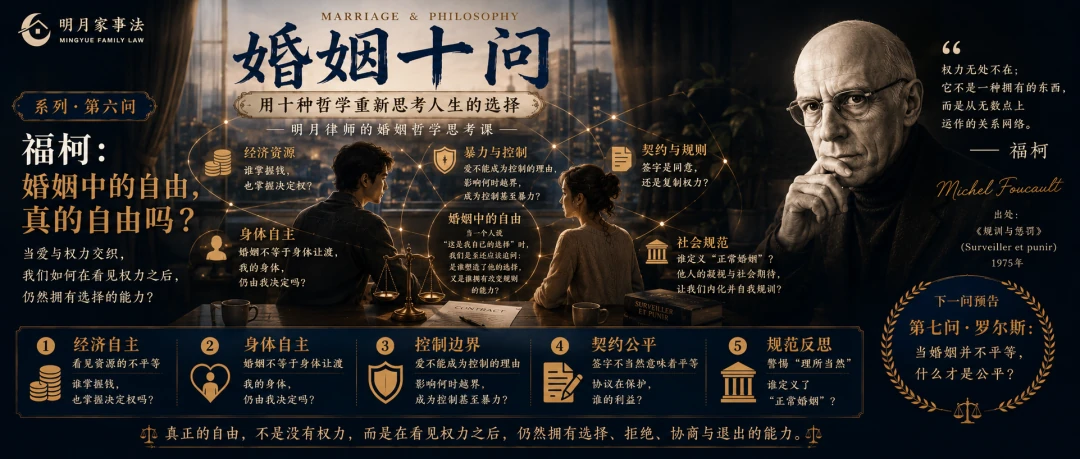
Many clients enter my office saying: “In this family, he decides everything.”
Sometimes this power is easy to see.
One spouse controls the main income: “I earn the money, so of course I should decide what happens at home.” The other gradually leaves employment to have children and care for them and elderly relatives. More than a decade later, she discovers that despite giving so much to the family, she has less and less capacity to leave it.
Sometimes power is more deeply concealed.
“He has never hit me, but he controls my bank cards, salary and every expense.” “We are planning to marry, but he insists on a prenuptial agreement. Without my signature, the wedding may not happen.”
Other questions are rarely discussed openly.
After marriage, who decides whether to have children, when to have them, whether to use contraception, or whether sex takes place? When one person says no, is the other genuinely willing to accept it?
These questions seem different, but behind them lies the same word: power.
This is the sixth of our Ten Questions on Marriage. The first five explored the people within marriage. Stoicism distinguished what we can control. Existentialism insisted that nobody can choose for us. Nietzsche considered self-creation after suffering. Plato reconsidered love's direction. Buber reminded us to encounter a whole “Thou”, rather than an “It” serving our needs.
Now a harder question emerges: even when two people marry in love, why can domination, dependence and control still arise? Further, when we say “This is my own choice”, does that choice entirely belong to us?
The French philosopher Michel Foucault may help us reconsider this.
ENGLISH READING GUIDE
Foucault
- Power may appear in resources, routines and expectations.
- Ask which social norms have become unquestioned obligations.
- Notice whether each partner can meaningfully disagree or say no.
A concise reading guide based on this essay; not a word-for-word translation of the original poster.
View the original Chinese learning poster
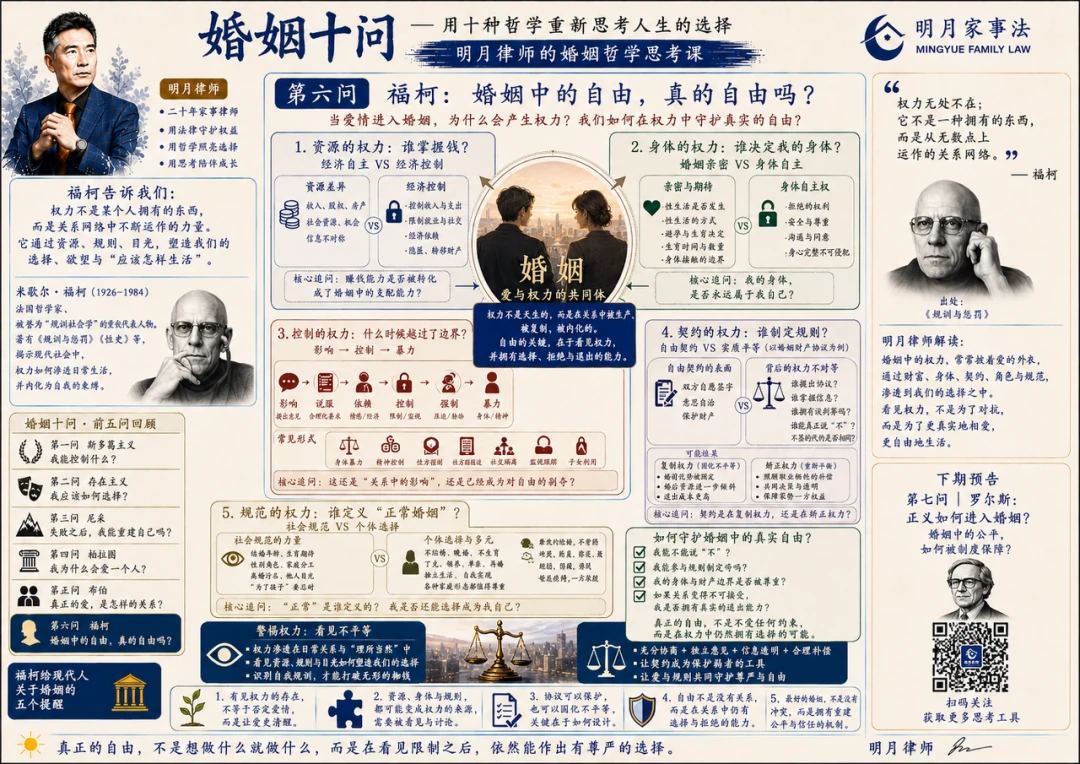
1. Power exists not only in the state, but in intimate relationships
When we hear “power”, we usually think of governments, courts, companies or organisations, as though power exists only when one person can order another around. Foucault changed that understanding. In his thought, power is not simply a thing someone possesses. It resembles a network. Wherever people influence one another, guide conduct, distribute resources or establish rules, power relations may exist.
Marriage is therefore no vacuum of power. A husband may command more economic resources while a wife carries more care responsibilities. One may possess more social connections and specialist knowledge; the other, after years outside employment, may grow increasingly dependent on marriage. What first looked like a division of labour can gradually change: differences in income become differences in resources; resources become influence; influence becomes decision-making authority.
An entrepreneur husband may say: “I support this whole family.” “Could you live like this without me?” “I built the company, so naturally I should decide.” But if the other spouse has spent years bearing and raising children, doing housework and caring for elderly relatives, is one person's business success really theirs alone? Market labour can be measured through salary, equity and business valuations. Household labour is much harder to price accurately.
The law does try to respond. Rules on marital community property and compensation for domestic work recognise household labour to differing degrees. Yet law still struggles to calculate the value of forgone promotion, ten years of career interruption, lost social connections and professional skills, or the difficulty of returning to employment.
The first question of marital power is therefore not who earns more, but whether earning power is becoming the power to dominate someone else.
2. Marriage creates intimacy, not a transfer of bodily ownership
The body is another important theme in Foucault's work. Power acts not only on property and behaviour, but also on bodies. Within marriage this raises sensitive, unavoidable questions: who decides whether sex happens, whether contraception is used, or when children are born? If one wants children and the other does not, whose view takes priority? If one refuses sex, does the other truly recognise that refusal?
It is easy to treat marriage as automatic bodily permission, as if becoming spouses naturally opened all bodily boundaries to each other. That assumption needs examination. Marriage establishes intimacy; it does not give one person ownership of another's body. A simple question matters profoundly: after marrying, do I remain the subject of my own body? Real intimacy should not remove bodily boundaries. Real love should not extinguish the ability to say no.
3. From influence to control: when does power cross a boundary?
Spouses inevitably influence each other. No intimate relationship can eliminate mutual influence. We persuade, compromise, accommodate and change for our families. The question is not why power exists, but when it becomes control. “I wish you would see that friend less” becomes a ban on friendships. “We should manage spending responsibly” becomes confiscating bank cards and restricting reasonable living expenses. “I wish you would come home earlier” becomes constant checks of location and phone. Joint discussion of children becomes unilateral decision-making. Arguments develop into humiliation, threats, intimidation or physical violence.
The dividing line is not always clear. One important Foucauldian reminder is not to wait for violence before noticing power. Early control may even wear the language of love: “It is for your own good.” “It is because I care so much.” “I am only worried about our family.” “For the children, you should…” Sometimes the most troubling power does not openly demand obedience. It gradually persuades you that this is simply what you ought to do.
4. Does signing a marital agreement necessarily mean freedom?
This question particularly deserves a family lawyer's attention. Modern law gives significant weight to autonomy: couples may sign property agreements before marriage or make arrangements during it.
From a conventional contractual perspective, the matter may appear simple: both are adults with full civil capacity, and both signed, so this is their choice. Foucault prompts us to go further. Who proposed the agreement? Who owns more property, has more information, and has a lawyer and financial adviser? Who drafted it? Who can bear negotiations failing? Imagine one person owns businesses, shares, homes and substantial premarital wealth. The other plans to marry, have children and perhaps reduce paid work to spend more time on the family. The stronger party says: “Of course we can marry, but first you must sign this.”
Formally, the other can refuse. But does she have the same practical ability to refuse? If refusing means the marriage cannot proceed, if one side commands all professional resources, and if the other does not even know the extent of the assets, sitting at the same table does not imply equal bargaining power. A signature can evidence agreement without necessarily establishing equality. This does not make marital agreements inherently bad. They can also correct imbalances: providing security when childbirth leads one spouse to leave employment, compensation for sustained domestic labour, protection of the family home, allocation of asset growth, and safeguards against a spouse progressively losing economic independence.
The real question is therefore not simply whether to sign an agreement, but whether it entrenches an existing imbalance of power or helps correct and rebalance it.
5. Foucault's deeper insight goes further
So far we have discussed relatively visible power: who controls money and property, decides about sex, drafts the agreement, or has greater ability to leave.
Foucault's deeper insight is that effective power may require no particular person to command us. Society constantly tells us what a good husband, good wife, responsible mother, successful man or complete family should be. These standards need not be written into law or repeated by someone beside us every day. They are everywhere: in parents, schools, workplaces, media, friends, the families we grew up observing, and society's imagination of a normal life.
Over time we measure and discipline ourselves by these standards. Foucault's ideas of discipline and normalisation are particularly useful for understanding this aspect of marriage.
6. Power goes deepest when we begin to discipline ourselves
In Discipline and Punish, Foucault discussed the famous architectural model of the Panopticon. Its distinctive feature is not uninterrupted observation, but prisoners' uncertainty about when they are being watched. This produces an efficient result: even when nobody watches, they regulate themselves as though someone might. Supervision moves from outside to within.
This offers a striking marital analogy. Nobody may explicitly order a woman to sacrifice her career for her children, yet she tells herself: “How could a good mother fail to put her children first?” Nobody may command a man to shoulder every financial responsibility, yet he tells himself: “A man who cannot provide is a failure.” Nobody may actually prohibit a deeply unhappy couple from divorcing, yet they repeatedly ask what parents, friends and colleagues will think, whether the children will blame them, and whether others will regard their lives as failures.
Gradually the supervisor is no longer a particular person, but a gaze internalised within us. Others' eyes become social norms; norms become self-scrutiny; self-scrutiny becomes self-restraint. Nobody needs to tell us how to live because we have begun telling ourselves that this is how we should live. This may be marriage's deepest form of power.
7. Does “my own choice” necessarily mean freedom?
We can now return to this essay's central question. A woman says: “Nobody forced me. I chose to leave my job and care for the children.” This may indeed be a genuine, autonomous choice deserving respect. Foucault nevertheless asks how that willingness took shape. Through childhood gender education? Her mother's example? Praise for “good mothers”? Her husband's expectations? A workplace inhospitable to women of childbearing age? Or a rational response to the couple's actual income difference?
Here Foucault is easily misunderstood. He is not simply saying that we think ourselves free but have no freedom. His challenge is that identifying a choice as our own should not end inquiry into how that choosing self was formed. This creates an interesting dialogue with existentialism, discussed in Question Two.
Existentialism tells us we must choose. Foucault asks who shaped the person doing the choosing.
Existentialism asks what you choose. Foucault asks who formed the choosing you.
His inquiry does not deny freedom. It asks a deeper question about it.
8. Power does not bear only on the supposedly weak
This is equally important. Reducing marital power to husbands oppressing wives, wealthy people controlling poorer people, or the strong dominating the weak oversimplifies Foucault again.
Power resembles a network. An entrepreneur husband may have enormous economic influence at home while being tightly bound by another set of rules: men must not fail, show vulnerability or stop earning; the head of the family must bear everything.
A person may exercise power in one relationship and be subject to it within another set of norms. The same is true of a wife: economically disadvantaged, she may nevertheless exercise influence through parent-child relationships, family emotions or everyday arrangements. Marital power is not a simple straight line from strong to weak.
It is a changing network. We influence and are influenced; we shape others while society, family and relationships shape us.
9. From Buber to Foucault: see each other, and the forces shaping us
Buber told us not to turn a loved one into an “It”: a real relationship acknowledges that you do not exist to complete my life; you are a whole, independent “Thou”. Foucault takes this further. Even when I respect and listen to you, and we still love each other, wealth, bodies, gender roles, marital agreements, family responsibilities and social norms may form complex power structures between us.
We must therefore ask not only whether I truly see you, but what forces are shaping both of us—and who we are being made into within this marriage.
10. Real freedom may begin with seeing power
If power is everywhere in marriage, must we conclude pessimistically that freedom is impossible? I do not think that is Foucault's final answer. Particularly in his later work, he increasingly asked whether people could understand and shape themselves anew within existing power relations and social norms.
This leaves another possibility for marriage. Freedom may not mean complete freedom from influence; such a life scarcely exists. Partners, parents, children, law, culture and society inevitably affect us. What matters is whether we can see those influences and ask why we believe husbands must behave one way and wives another; why divorce means failure; why good mothers must sacrifice themselves; why men must not be vulnerable; why marriage supposedly entitles us to bodily satisfaction; or why a signature supposedly makes everything fair.
Freedom may begin when we first question these apparent givens.
What marriage should pursue may therefore be less a world without power than one where power is visible, control has limits, bodies retain autonomy, vulnerable people have protection, contracts are fair, and supposedly obvious rules remain open to discussion. Above all, a person's no must be heard. When arrangements no longer work for both, they must be able to renegotiate. When someone cannot continue, a real capacity to leave must remain.
Perhaps this is freedom within marriage: living not outside power, but recognising the forces shaping us and still asking whether this is the life we want. If it is not, do we retain the courage to choose again?
In this sense, Foucault does not prescribe the correct marriage. He holds up a mirror to power concealed within love, responsibility, property, bodies, contracts and claims of acting for our good. Freedom may begin with the first realisation that what we always thought inevitable can be thought about anew.
Is freedom within marriage truly free? Three questions from Mingyue Gao
Question 1
Which arrangements in my marriage have I always considered self-evident? On examination, do these expectations come from me, or from parents, my partner, society and an image of the normal family?
Question 2
When I say “It is for your own good”, “For the children”, or “This is what spouses should do”, am I expressing love and responsibility—or using reasonable-sounding language to decide someone else's life?
Question 3
If I truly disagree with an arrangement concerning money, children, my body, sex, a property agreement or our way of life, can I actually say no, renegotiate, or choose again?