English translation of the Chinese original. Original illustrations are retained, including text within images. Translation and web presentation: 7 October 2026.
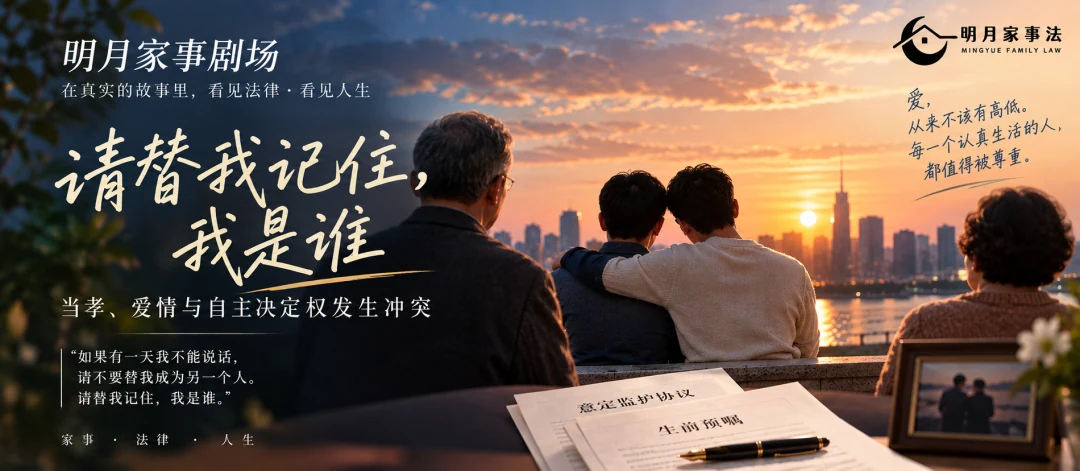
Please Remember Who I Am
When filial duty, love and self-determination collide
Mingyue Gao’s note
Falling in love is deeply personal. But when two men fall in love, it can suddenly become their parents’ pain, a family conflict, even a question the law must confront.
The parents say: “We love you. That is why we cannot accept your living this way forever.”
The son asks: “If loving you requires me to stop being myself, is that still filial duty?”
Then illness strikes, and a sharper question emerges: when someone can no longer fully express himself, who is best placed to preserve the self he was when he could?
Those who gave him life? Those who raised him? Or the person he freely chose while able to decide?
This instalment of Mingyue Family Theatre goes beyond same-sex partners’ rights. It asks: to whom does an adult’s life belong?
Characters
Zhou Qiming — Thirty-four, an only child, well educated, with a stable career. He gradually recognised his sexual orientation in adolescence but took years to accept himself.
Chen Yu — Thirty-six, an architect, Qiming’s partner for eight years. They have lived together for six. Gentle and restrained.
Qiming’s father — Sixty-seven, a retired engineer. Traditional and quiet; deeply loves his son.
Qiming’s mother — Sixty-four, a retired teacher. Her son is her greatest pride, making his departure from her expectations particularly hard to accept.
Mingyue Gao — A family lawyer who welcomes and supports gay clients.
Act I: “You Need Not Marry, but You Cannot Live Like This Forever”
The Zhou family home. Dinner.
His mother has cooked his favourite dishes. Halfway through, she begins as usual: “Auntie Wang’s daughter is back in Shanghai. She’s a lovely prospect. I’m not forcing you to marry. Just meet her.”
Qiming looks down, then puts down his chopsticks. “Mum, I won’t meet her. I won’t marry a woman.”
She freezes.
After a long pause: “There is already someone I love. For eight years.”
Delight briefly crosses her face. “Eight years? Why have you never told us? What’s her name?”
Silence.
“Chen Yu. Yu as in ‘island’.”
His father slowly looks up. “A man?”
Qiming nods.
Silence falls over the table.
His mother stares. “What do you mean?”
“I’m gay. Chen Yu is my partner.”
Tears suddenly fall. “You must be joking. How will we face people? What happens to this family?”
His father says quietly: “Enough for now.”
But she cannot stop. “You’re our only son. If you don’t marry or have children, what happens later? At fifty? Sixty? Who will look after you when we die?”
Qiming does not argue. Much later, he says only: “Mum, I did not come into this world solely to give this family a child.”
His father looks sharply up.
Lights fade.
Act II: “We Only Want You to Be Happy”
Months later, his mother visits his home for the first time.
Chen Yu opens the door. “Hello, Auntie.”
She does not answer. Two pairs of shoes at the entrance; two toothbrushes in the bathroom; medicine for Qiming’s stomach in the fridge.
Travel photographs of the two men hang on the wall. A note on the fridge reads: “Qiming: no coffee after ten at night.”
She stares at it. She had thought her son was just beginning down a “wrong path”. This stranger had actually shared his life for six years.
Before leaving: “How long have you lived together?”
“Six years,” Chen replies.
She says no more until they reach downstairs. “Qiming, it isn’t that I don’t love you. I cannot accept this because I do. You’re young and think love solves everything. But later? Who helps when you’re ill? Who acts when the hospital needs family? Who will be your family when you’re old?”
He looks at her. Eventually: “Mum, perhaps I have already thought about that.”
She does not understand.
Act III: “If One Day I Cannot Speak”
Two years earlier, Mingyue Gao’s office. On the desk: a voluntary guardianship agreement, an advance healthcare directive, and documents addressing medical wishes, personal affairs and property management.
Qiming and Chen sit side by side, opposite Gao.
Gao: One last time, Qiming. Why Chen Yu?
Qiming thinks. “He understands me best. He knows my fears, what dignity means to me, when I would want treatment to continue and how I would want my final days to be if medicine could only prolong suffering.”
He pauses. “My parents love me very much. Precisely because of that, they may find some of my choices too painful to respect.”
Chen lowers his head.
Gao: Do you understand what voluntary guardianship really means?
Qiming nods.
Gao: It is not handing your life to another person. It is making arrangements while you can decide, for a future in which you may not be able to.
Qiming looks at Chen. “If that day comes, I don’t want him to turn me into someone else. I want him to preserve the voice of the me who could speak clearly.”
Act IV: “I Am His Mother”
Two years later. Qiming suddenly develops a serious illness. Hospital.
Chen arrives first, then the parents. The doctor explains. His mother barely takes it in, repeating: “Save him. Whatever it takes.”
The doctor asks whether the patient left medical wishes or other arrangements.
“Yes.” Chen produces documents.
His mother freezes.
One document, then another.
She sees Chen’s name. “What does this mean?”
He does not answer.
She keeps turning pages: voluntary guardianship, advance directive, medical wishes, all notarised.
“Why is it always you?”
Quietly: “Qiming arranged it himself.”
She loses control. “I am his mother!”
The corridor falls silent. “I gave birth to him! I raised him for over thirty years!”
Holding up a document: “Why are you the one to speak when his life is at stake?”
Chen does not argue.
Eventually: “Auntie, I did not choose myself. Qiming chose me.”
Act V: “Because He Feared You Could Not Let Go”
His father, silent until now, reads the advance directive page by page. “When was this done?”
“Two years ago.”
“Why didn’t you tell us?” Chen is silent.
“Why did he choose you?”
Chen’s eyes redden. “Uncle, he said that if medicine could no longer restore him, only prolong his suffering—”
His mother interrupts: “Stop! He would never think that!”
Chen gently lays the paper before her.
“It isn’t what I think. He wrote it himself.”
She is stunned. For the first time, she faces a cruel question: she may be among those who love him most, but does loving most necessarily mean understanding best?
Act VI: “Do You Know What He Fears Most?”
Qiming gradually stabilises but has not fully regained consciousness.
Late at night, his father and Chen sit in the corridor.
“What does he fear most?” his father suddenly asks.
Chen thinks. “Losing dignity. His grandmother spent her final years bedridden. He often told me he feared becoming wholly unconscious, with machines keeping him alive.”
His father lowers his head. Later: “You know about his stomach?”
Chen smiles. “Yes. No coffee on an empty stomach.”
His father smiles too. “Since he was little.”
Silence.
For the first time, they discuss neither homosexuality, filial duty nor continuing the family line, but the same Qiming. His father knows he feared darkness at seven, cried all night on first leaving home for boarding school at twelve, and knows his entrance-exam score.
Chen knows why he lost sleep after thirty, what he said when work overwhelmed him, where he wants to grow old, and what he wants others to say for him if he cannot speak.
“Has it really been eight years?”
Chen nods.
His father looks towards the room. Much later: “Then I missed eight years of him.”
Act VII: “Why Aren’t Parents Automatically the Decision-Makers?”
His mother visits Gao and lays down the documents. “I am his mother. Why am I not the one deciding now?”
Gao asks: “If Qiming woke and clearly told the doctor what he wanted, whose wishes should be heard?”
“His, of course.”
Gao nods. “Then we have a starting point. When an adult cannot fully express himself, the question should not be who is most entitled to live his life for him. It should be how to respect his genuine, clearly formed and sustained wishes as far as possible.”
He returns the documents. “Chen is not displacing you as his mother. You will always be his mother. But motherhood does not mean ownership of an adult’s life.”
Tearfully: “But I love him most.”
Gao: I believe you. But guardianship is not a competition in love. It rewards neither parents nor partners. It protects Qiming himself.
A pause.
“That is why, in voluntary guardianship, I think the crucial word is not ‘guardianship’ but ‘voluntary’—the person’s own choice.”
Act VIII: “Is Their Love Worth Less?”
After a long silence, his mother asks: “I admit Chen treats him well. But…” She hesitates. “Can love between two men really be like love between spouses?”
Gao takes a case-study book from the shelf, received during his invited visit to Yale Law School the previous year. It concerns the landmark 2015 US Supreme Court decision Obergefell v. Hodges and was written by a lawyer who represented parties in the case.
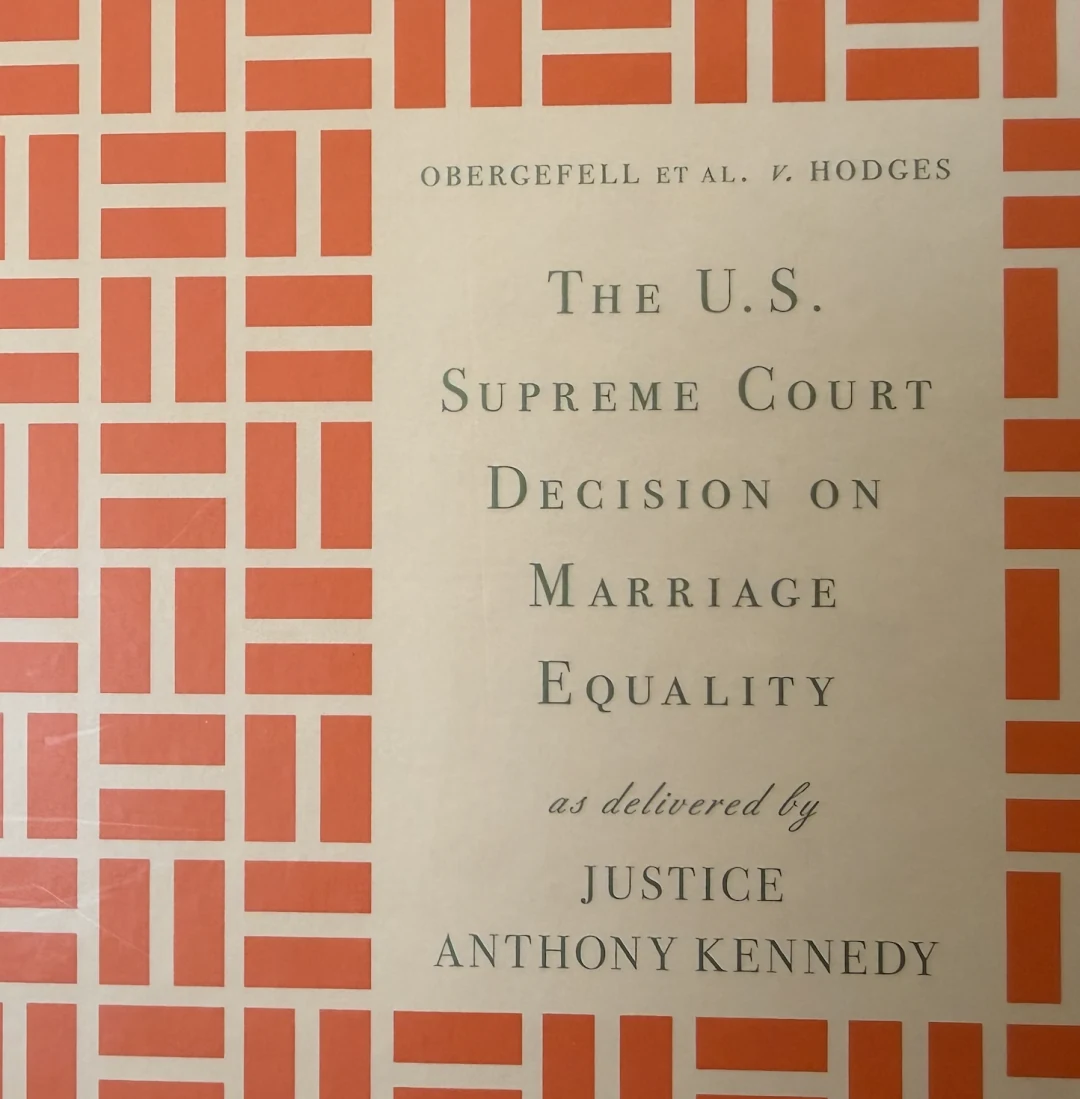
His father asks: “The American same-sex marriage case?”
“Yes. What is interesting is that it did not pretend tradition did not exist. It recognised marriage’s long history and development around male-female unions. Then it asked something harder: history and tradition tell us where we came from, but must they forever determine the limits of freedom?”
His father: “But hasn’t family meant a man and a woman for thousands of years?”
Gao nods. “That is the difficulty. Tradition deserves respect, but marriage itself has changed throughout history. The judgment asks why marriage warrants such serious protection: personal choice, profound intimacy, companionship, commitment, care and family. Can these exist only between a man and a woman?”
No one answers.
Act IX: “What Deserves to Be Called Love?”
Gao puts the American case aside. “Set aside even homosexuality for a moment. Consider two people: eight years, living, eating, travelling and facing illness together. Chen remembers Qiming’s medicine. He knows how Qiming fears losing dignity. While healthy and able to express himself clearly, Qiming chose to entrust his most vulnerable future self to him.”
He looks at the mother. “If that is not love, what more must there be before it deserves the name?”
She lowers her head.
Gao: I cite Obergefell not because American law can answer China’s questions. It cannot. China’s current marriage system does not permit same-sex marriage. But lacking marital status and having a relationship of lesser human worth and dignity are entirely different things.
He turns to the end of the judgment. “Its famous words are: ‘They ask for equal dignity in the eyes of the law.’ It does not claim same-sex love is superior. It asks whether, when two people seek companionship, fidelity, responsibility, intimacy and a shared life, their being two men justifies treating their love as lesser from the outset.”
She does not answer.
Act X: “America Is America; China Is China”
His father speaks: “But America is America. China has no same-sex marriage. Are Qiming’s arrangements valid here?”
Gao nods. “An important question. Chinese law does not give same-sex partners spousal status. But an adult without that status can still plan using institutions current law permits.”
Pointing to the documents: “That is why he needed to consider a will, property arrangements, authorisations, voluntary guardianship and medical wishes. Some protections flow from marriage for different-sex spouses; without that status, same-sex partners have greater need for active planning.”
His father studies the papers.
Gao: I am not using US law to explain Chinese reality. I borrow the judgment to ask: if law has not given them the name of marriage, may we pretend their shared life does not exist?
Act XI: “The Person You Each Know Is Me”
Qiming finally regains consciousness. His father visits alone and spends a long time peeling an apple. “Did you arrange that voluntary guardianship yourself?”
“Yes.”
“Why not choose your mum and me?”
After a pause: “Not because you don’t love me, Dad. Because you love me so much.”
His father stops peeling. “What do you mean?”
“If a doctor told you recovery was impossible, I feared you would still say: try again, another day, one more attempt.”
His eyes redden. “I’m your only child. But Chen knows when treatment is saving me, and when ‘saving me’ might only mean you cannot bear to lose me.”
His father looks down. “So he understands you better?”
Qiming shakes his head. “No. You know my childhood fears, my first tears at school, everything before eighteen. Chen knows what frightens me after thirty, how I want to age, what dignity means to me.”
He takes his father’s hand. “The person you each know is me.”
Act XII: “Must Filial Duty Cost Us Ourselves?”
After discharge, all four sit before Gao again.
His father asks: “Our generation always thought children marrying, having children and continuing the family was natural. Were all our hopes wrong?”
Gao shakes his head. “No. Hope is not wrong. Disappointment is not wrong. Nor is needing time to understand. Parents do not lose feelings when children grow up. But hopes and decision-making authority are different.”
He turns to Qiming. “Adult freedom does not eliminate responsibility either. He must still care for his parents and meet legal and ethical duties. This is not freedom versus filial devotion. The question is whether devotion requires self-erasure: a man marrying a woman he does not love; an innocent woman entering an untrue marriage for the family line; an adult denying the most important person in his life.” He looks at the parents. “Are we protecting a family—or demanding that someone sacrifice himself to preserve our imagined family?”
No one answers.
Epilogue: “Please Remember Who I Am”
Lunar New Year. Qiming has not planned to go home. At four, his father sends a message: “Come for dinner.” A minute later: “Bring Chen Yu.”
At half past six, the bell rings. His father opens the door. “Happy New Year, Uncle,” Chen says.
His father steps aside. “Come in.”
His mother emerges from the kitchen, still awkward. She points to the shoe cabinet. “New slippers are underneath.”
Four places are laid.
During dinner, she asks: “Qiming, that… advance directive of yours.”
Everyone stops.
“Could you explain it to me sometime?”
He is startled.
She looks down, serving food. “Your father and I are getting older. If that day comes…” She pauses. “We would like to have our own say too.”
Qiming’s eyes suddenly redden.
No one speaks.
Then his father raises a glass towards Chen. “At the hospital… thank you.”
Chen shakes his head. “No need, Uncle.”
“There is. I always thought you were just Qiming’s…” He stops. He was going to say “friend”, but does not. Instead, he extends the glass. “A little drink?”
Chen smiles. “Yes.”
Four glasses touch gently.
No one announces acceptance or the end of family conflict. Reconciliation rarely transforms decades of values overnight. It may mean one more place at the table, another pair of slippers, and finally acknowledging that this person truly shares their son’s life.
A Question from Mingyue Gao Behind the Scenes
On the surface this concerns a same-sex couple. Remove that label and it asks something any family may face: to whom does an adult’s life belong? Parents may hope, feel disappointed or struggle to understand. Does loving a child authorise deciding whom he loves, whom he lives with, how he forms a family, or how he is treated at his most vulnerable?
Voluntary guardianship and advance healthcare directives touch the same question: can the clear-minded person I am today leave a voice for a future self unable to speak?
In Obergefell v. Hodges (2015), the US Supreme Court addressed the constitutional question of same-sex marriage. It prompts another reflection: do differences in legal status create a hierarchy of love? Same-sex love is not inherently lesser because the partners share a sex. Companionship, fidelity and care remain what they are. Entrusting oneself at one’s most vulnerable to another person deserves serious regard.
For same-sex partners without marital protection, this also means a practical legal need. Less automatic protection makes active planning more important: wills, property arrangements, authorisations, voluntary guardianship and medical wishes cannot create a marriage the law does not recognise, but can help genuine wishes receive greater respect within existing law.
Ultimately, this is not only about whether parents should accept homosexuality. It asks: when I deeply love someone but cannot understand the life they choose, can I still respect it as theirs?
Perhaps law’s deepest humanity lies not in prescribing one correct life, but in recognising agency, free will and dignity as different people choose different lives. Among an adult’s most important rights may be deciding whom to love, who understands them best, and saying while still able: if one day I cannot speak, please remember who I am.
Legal Note
This is a fictional work in the Mingyue Family Theatre series; its characters and events are artistic creations. Voluntary guardianship, advance healthcare directives, medical wishes and authorisations have different legal characteristics and requirements for creation and effect. Particular medical decisions remain subject to China’s current healthcare laws, clinical rules and circumstances. The story explores adult autonomy, advance planning and intimate relationships; it is not legal advice for a specific case. Obergefell v. Hodges, 576 U.S. 644 (2015), is a US Supreme Court decision cited for comparative-law and jurisprudential discussion, not as a source of current Chinese law.